



Medical Education in India: Why Quality Matters More Than Quantity
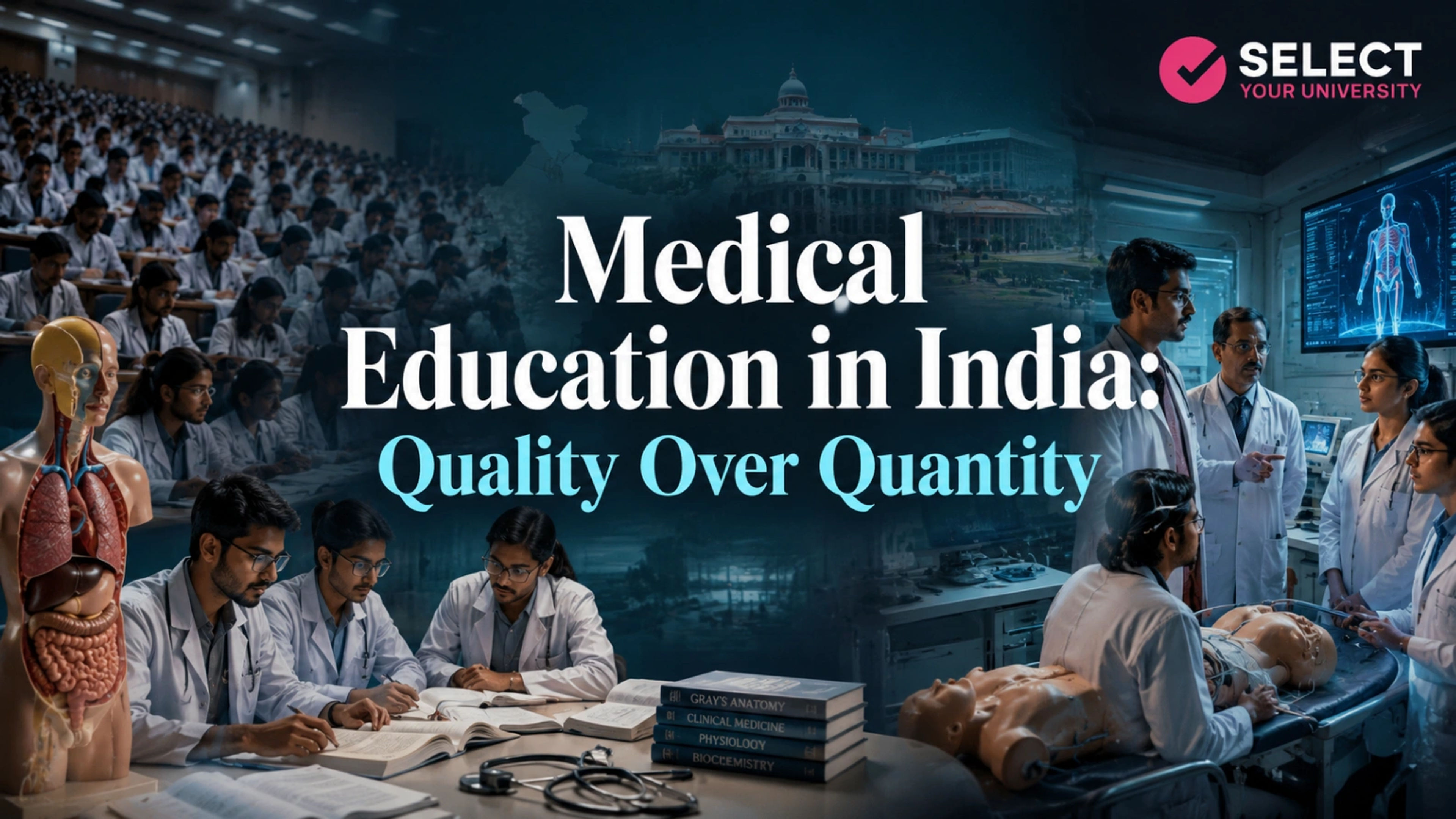 Medical Education in India
Medical education in India is one of the biggest changes in the history of the world. In recent years, India has been building up medical colleges at a very rapid pace to meet the demand for Indian doctors. Few years back there were 600 medical colleges in India, and now there are more than 800 medical colleges which offer medical courses & post-graduate medical courses. Also, MBBS seats in India have been increased from 83,000 to approximately 1.29 lakhs, whereas postgraduate seats have now reached 85,000 nationwide.
This growth has created more opportunities for the NEET aspirants. Recently, with the issue of NEET UG 2026, problems in the exam, shortage of faculty and lack of PG seats in medical colleges, one is again wondering whether India has followed the path of quantity rather than quality in Medical education.
The future in Indian Healthcare is about building the capability, skill and competence of doctors to meet the challenges of the present healthcare world.
Rapid Growth of Medical Colleges in India
Over the past decade, India has seen a remarkable rise in the number of MBBS seats and medical colleges. The government's efforts to make the doctor-to-patient ratio better have led to the establishment of new medical colleges, particularly in the less-served areas.
Key Growth Trends in Medical Education
Below is shown the key growth trend in Medical education in India.
- The seats filled up for MBBS in India alone are more than 1.25 lakh.
- Presently, the number of medical colleges in India is more than 800.
- Almost 85,000 seats in PG medical courses are available for grabs.
- Furthermore, an increasing number of private medical schools are getting involved.
- Tier-2 & Tier-3 cities also witness the creation of Medical education hubs.
The number of private and government medical colleges has increased at a great pace in several states such as Madhya Pradesh, Uttar Pradesh, Karnataka, Maharashtra and Tamil Nadu.
The Real Challenge: Quality Over Quantity
One of the most challenging scenarios of medical education in the present time is maintaining the quality of education and also expanding the number of seats. The problem of infrastructure, faculty shortage, poor patient flow and less clinical exposure to students are common challenges faced by many newly established colleges.
Additionally, medical education needs:
- Strong clinical training
- Experienced faculty
- Practical patient exposure
- Modern laboratories
- Research opportunities
- Technology integration
Without these essential elements, simply increasing MBBS seats may compromise the quality of future doctors.
NEET UG 2026 and the Need for Reform
NEET UG is the main foundation of admission to MBBS in India. Each year more than 20 lakh of students compete for the government seats in medical colleges across the country, and NEET is one of the most competitive medical entrance exams in the world.
But, the worries about examination management, allegations of paper leakage, stress amongst students and coaching dependence have raised questions on the future of NEET.
Challenges Associated with NEET
Experts believe NEET exam pattern should be changed and should concentrate more on analytic thinking, problem solving and clinical reasoning instead of memorising the answers. Here are the priorities in order of importance.
- Extreme competition pressure
- Dependence on rote learning
- Coaching culture dominance
- Mental health stress among aspirants
- Aspirants' mental health stress
Some of changes which should be introduced in NEET 2027 and subsequent years:
- AI-based examination monitoring
- Stronger cybersecurity systems
- Competency-based assessment patterns
- Reduced dependence on rote learning
- Better mental health support for aspirants
Faculty Shortage in Medical Colleges
Low staff strength of qualified faculty members is one of the major problems in medical colleges of India. With the increasing number of colleges, it is hard to recruit experienced professors and clinicians.
Certain subjects, such as pre-clinical and para-clinical subjects, are especially vulnerable as there is less interest in the post-graduate medical education in these specialisations.
Major Reasons Behind Faculty Shortage
This deficiency has a direct impact on the learning of the MBBS students and could be a long-term problem in clinical competency.
- Rapid increase in medical colleges
- Limited postgraduate specialists
- Migration of doctors abroad
- Preference for clinical practice over teaching
- High workload and burnout among faculty
Why Clinical Exposure Matters in MBBS Education
Once the student has entered into the hospital setting, the real training of the doctor begins. Medical students need to increase their confidence, decision making ability, and ability in handling patients, which can be developed with good clinical exposure.
Newly established medical colleges have problems like:
- Low patient inflow
- Limited hospital infrastructure
- Inadequate clinical departments
- Shortage of experienced specialists
Therefore, NEET candidates are not just focusing on securing admission in MBBS courses but also on securing the best and reputed medical colleges.
Technology and AI Are Reshaping Medical Education
AI, digital health, and cutting-edge diagnostics are key components of the healthcare future. The use of AI in medical education has been seen across the world and India is no different. AI has already become a part of medical training across the globe, and India needs to adapt rapidly to stay competitive.
Importance of AI in Medical Education
Here is why AI is important or required in medical education.
- AI-assisted diagnostics
- Digital patient records
- Virtual simulations for learning
- Predictive healthcare analytics
- Telemedicine integration
The medical colleges in India should have a new syllabus with the following things:
- AI fundamentals
- Digital healthcare systems
- Medical data analysis
- Research methodology
- Evidence-based medicine
Research in Indian Medical Colleges Needs Improvement
India has a vast number of research papers which are being created annually, but somehow it lacks in real-world clinical situations. Most of the research projects are still ongoing, for the sake of academic promotions, not merely for medical innovations.
Areas That Need Improvement
Areas that need to be top priority concerns for the medical colleges.
- Translational medical research
- Public health studies
- Clinical innovation
- AI-based healthcare research
- Rural healthcare solutions
The Rising Cost of Medical Education
The other important issue is rising education costs in private medical colleges. The government colleges are economical, but the private MBBS colleges in India may charge more than ₹1 crore. This places a financial burden on families and results in the inability to secure a medical career for a deserving student.
- Experts recommend there be:
- Better fee regulation
- Transparent admission policies
- Scholarship opportunities
- Affordable education loans
- Increased government medical seats
- Medical education must be affordable for an equitable health care system.
Conclusion: Key Reforms Needed in Medical Education
India has built up its medical education capacity, but the next step is to enhance the quality, innovation and learning-centred approach in medical education.
- Facilitate faculty recruitment in medical colleges – good faculty development programmes and incentives and digital teaching mechanisms are required.
- Clinical Infrastructure Improvement - Hospitals linked with Medical Colleges should have good patient exposure and be equipped with good healthcare infrastructure.
- Reforms in the NEET Examination Pattern - NEET should be made a competency-based and analytical examination system.
- Inculcate Technology and Artificial Intelligence – Medical students should be taught about digital healthcare and various technologies that involve Artificial Intelligence and modern diagnostics.
- Promote Research Culture – Medical institutions ought to promote adequate clinical and public health research.
- Mental Health - Mental health programs for students are becoming more and more important, as are mental health systems.
Frequently Asked Questions
Ques. Is there any increase in MBBS seats in 2026?
Ans. Yes, the number of seats available for admission in MBBS in India has increased immensely for the year 2025-26. To enhance healthcare access and the supply of doctors, the government has approved new medical colleges and additional seats in established medical colleges. The number of MBBS seats in government and private colleges in India has increased to over 1.25 lakh. But experts say it is just as crucial to keep up with the number of seats, faculty and clinical exposure, when the number of seats is increased, and quality medical education is provided.
Ques. Can AI replace MBBS doctors?
Ans. No, AI is not a substitute for MBBS doctors as medicine involves human intuition, empathy, communication, and clinical judgment. AI is a valuable tool for physicians in diagnostics, medical imaging, patient monitoring, and data analysis, but it can never replace the human touch of a physician and patient. In summary, AI is poised to have a major impact on the future of healthcare by assisting healthcare professionals with accuracy and efficiency. To make medical students familiar with digital health and AI applications apart from medical education and clinical training.
Ques. How many new seats are added in NEET 2026?
Ans. All over India, thousands of additional seats are added for NEET UG 2026. As medical colleges are growing at an accelerated rate, thousands of new seats are being added in MBBS for NEET UG 2026. The overall MBBS seats across the country are now close to 1.25 lakh. The increase is due to the establishment of new medical colleges (both government and private) in states such as Madhya Pradesh, Uttar Pradesh and Maharashtra. The main purpose of installing seats is to increase the number of doctors to patients and more opportunities for students to receive medical training.
Ques. Will MBBS be reduced to 4 years?
Ans. As of now, no official announcement has been made on the shoreline of reducing the duration of MBBS course to four years in India. The duration of the MBBS course is still 5.5 years with a compulsory rotational internship of a year. Discussions on the changes in the curriculum and the competency-based medical education are in the process, but the clinical exposure remains an important factor in justifying the current tenure. Good training at the hospital and experience in dealing with the patient's data are believed to be essential before students can go into the profession.
Ques. Why is medical education reform important in India?
Ans. Reforming Medical education in India is crucial because the medical field is rapidly evolving and there are constant advancements in technology, AI, research and patient care systems. There is a shortage of faculty members, a lack of infrastructure, problems with examinations, and high education costs are still prevalent in India despite the increase in seats and medical colleges. Reforms are required to enhance the quality of teaching, clinical exposure, research opportunities and integration of digital technologies in healthcare to prepare future doctors for the new challenges and the demands of patients.