


MBBS Fees Structure in India 2026: Government vs Private Medical Colleges
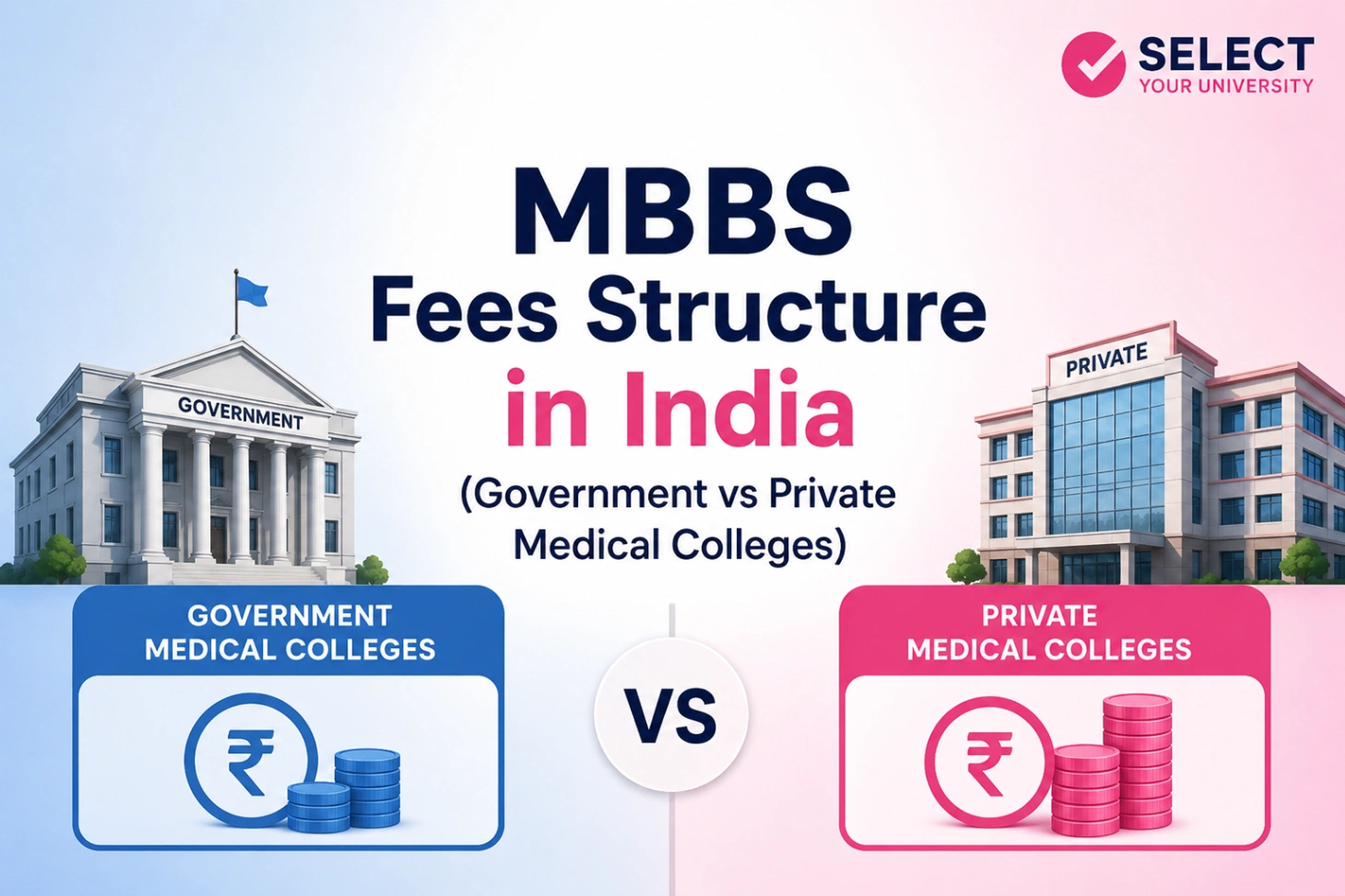 MBBS fee structure in India
Knowing the MBBS fee structure in India 2026 is necessary for students seeking MBBS admission in their suitable medical colleges in India. Therefore, all the MBBS aspirants in India need to analyse the MBBS Fees Structure in India 2026: Government vs Private Colleges for having a clear idea regarding this. As the re-NEET 2026 exam has happened, the focus of the students has shifted to MBBS admission and MBBS Degree Fees in India.
Analysing the expenses for MBBS in India includes two crucial factors, and those are checking the MBBS fees in government colleges and the MBBS fees in private colleges. Thus, considering the necessity of the students, this blog covers the aspects, such as the details of the MBBS fees in government Colleges, private MBBS colleges in India, with fees and a quick highlight on the MBBS fee structure in India 2025 in government and private colleges.
Must Read
- Top Colleges Accepting NEET in North India
- Colleges accepting NEET in South India
- Top Medical Colleges Accepting NEET Scores in East and West India 2026

MBBS Fees in Government vs Private Colleges in India 2026
The table below highlights an overall overview of the differences in fees in government and private medical colleges in India. Check: Top Government Medical Colleges in India.
College Type | Annual Fee | Total Fee |
Government Medical Colleges | Around ₹6,000 to ₹1,00,000 | Around ₹30,000 to ₹15,00,000 |
Private Medical Colleges | Around ₹8,00,000-₹30,00,000 | Around ₹40,00,000-₹1,50,00,000 |
Private Medical Colleges (Management Quota) | Around ₹12,00,000 to ₹30,00,000 | Around ₹60,00,000-₹1,50,00,000 |
MBBS Fees Structure in India 2026: Top Government Medical Colleges
The table below highlights the details of the college-wise MBBS fees structure in India 2026 in the top government medical colleges.
Top Government Medical Colleges in India | NIRF Ranking 2025 | MBBS Fee Structure (Total) |
1 | ₹12,150 | |
4 | ₹1,30,000-₹1,55,000 | |
6 | ₹1,51,000 | |
8 | ₹2,53,000 | |
13 | ₹51,520 | |
14 | ₹40,230 | |
Madras Medical College & Government General Hospital, Chennai | 16 | ₹68,020 |
19 | ₹24,100 | |
22 | ₹2,62,000 | |
23 | ₹43,150 | |
25 | ₹4,790 | |
26 | ₹55,650 | |
27 | ₹4,500 | |
29 | ₹2,19,000 | |
31 | ₹5,860 |
MBBS Fees Structure in India 2026: Top Private Medical Colleges
The table below highlights the details of the college-wise MBBS fees structure in India 2026 in the top private medical colleges.
Top Private Medical Colleges in India | NIRF Ranking 2025 | MBBS Fee Structure (Total) |
3 | ₹5,63,000 | |
9 | ₹1,19,00,000-₹2,03,00,000 | |
10 | ₹46,91,000 | |
11 | ₹1,22,00,000 | |
Dr D. Y. Patil Vidyapeeth | 12 | ₹1,39,00,000 |
Siksha `O` Anusandhan | 15 | ₹95,36,000 |
S.R.M. Institute of Science and Technology | 18 | ₹1,20,00,000 |
20 | ₹1,03,00,000-₹1,16,00,000 | |
21 | ₹1,35,00,000 | |
24 | ₹77,62,000 | |
30 | ₹30,00,000 | |
33 | ₹98,28,000 | |
35 | ₹38,45,000 | |
36 | ₹11,18,000 | |
37 | ₹6,91,000 |
Why do Government-run Medical Colleges in India Charge Low Fees
Government funding is the main reason for lower charges for completing MBBS courses in government-run medical colleges in India. The government provides favourable scholarships for MBBS students pursuing their degrees from government-run medical colleges. The table below highlights the details about the funding.
Particulars | Details |
Prime Minister’s Special Scholarship Scheme (PMSSS) | It is provided only to the students from Jammu & Kashmir. ₹10,0000 is provided to each student |
Pradhan Mantri Swasthya Suraksha Yojana (PMSSY) | It provides 100% of the course fees as funding to the students. |
Nationwide Education & Scholarship Test (NEST Senior) | The government provides ₹50,000 to the students pursuing MBBS and other related degrees in the medical field. |
Direct Institutional Grants | The Union Ministry of Health & Family Welfare offers this grant to government MBBS colleges in India. This helps to reduce the course fees |
PM-USP Yojana | This offers ₹20,0000 yearly to the students whose family income is under ₹4,50,000 per annum |
Why do Private Medical Colleges in India Charge High Fees
Students who cannot secure a seat in the government colleges always opt for the private colleges. However, the private medical colleges in India charge a high fee to the MBBS students for multiple reasons. Rising demand for medical professionals, high salaries for the faculty, expensive infrastructure and developing the capacity of dealing with high demand for medical colleges in India are the reasons.
Therefore, assessing and comparing the MBBS fee structure in India 2026 among the government and private colleges is necessary. The reasons for the high fee structure in the private medical colleges are described below.
Factors | Reasons for High Charge |
Infrastructure | The managing bodies always focus on investing in infrastructure |
Equipment | The management of the colleges always uses cutting-edge technologies. |
Faculty | The demand for skilled faculty is rising. |
High demand for medical colleges | The growing demand for medical colleges is another reason for the high fee structure. |
How to choose the right MBBS Colleges in India?
The table below demonstrates the details about the factors based on which the students can choose the right MBBS colleges in India.
Factors | Details |
Fees | The students need to check the course fees while taking admission to any medical college in India. |
Seat Availability | The students also need to check the seat availability as it defines the cutoffs and fees for that respective college. Seat availability also affects the fee structure |
Mess & Food Cost | The students also need to check for the mess, food costs and availability in the hostels |
State Fee Regulation | The students need to check the state fee regulation to cross-check the fee rules of the colleges located in respective states. |
Library & Laboratory Fees | Students should check the laboratory and library fees also to have a clear idea about the total MBBS fees |
MBBS Fees Structure in India 2026: Government vs Private Colleges: FAQs
Ques: Are private medical colleges in India expensive than the government medical colleges for pursuing MBBS?
Ans: Yes, in India, all private medical colleges are more expensive for MBBS courses than government colleges. The reason is that, unlike the government medical colleges in India, the private medical colleges in India are not subsidised. Due to this reason, students need to bear huge amounts to study MBBS in private colleges in India.
Ques: Why are the government medical colleges not expensive?
Ans: The government medical colleges are not as expensive as these get funding from the government, unlike the private medical colleges. Ranging from the admission charges, course fees, hostel fees, to study equipment, the government medical colleges in India get government funding.
Ques: What are the popular scholarships and funding opportunities for MBBS students granted by the government?
Ans: The popular scholarships and funding opportunities are PMSSS, PMSSY and NEST Senior. The scholarships help the students to have concessions in their course fees. Along with the PMSSS, PMSSY and NEST Senior, the MBBS aspirants can get other scholarships such as PM-USP Yojona, Post Matric Scholarships for SC/ST students, Merit-cum-means scholarships, Central Sector scheme of national scholarships and many more.
Ques: What is the most popular government-run medical college in India?
Ans: The most popular government-run medical college in India is AIIMS. It has branches in multiple cities and towns across India. The most popular branches are:
- AIIMS Delhi
- AIIMS Rishikesh
- AIIMS Jodhpur
- AIIMS Bhubaneswar
- AIIMS Bhopal
Ques: What are the common factors or high charges in private medical colleges in India?
Ans: The rising demand for medical professionals, high salaries for the faculty, expensive infrastructure and developing the capability to deal with the high demand for medical colleges in India are the common factors.