



NEET Exam Pattern 2026: Marking Scheme, Subject-Wise Weightage & Preparation Strategy
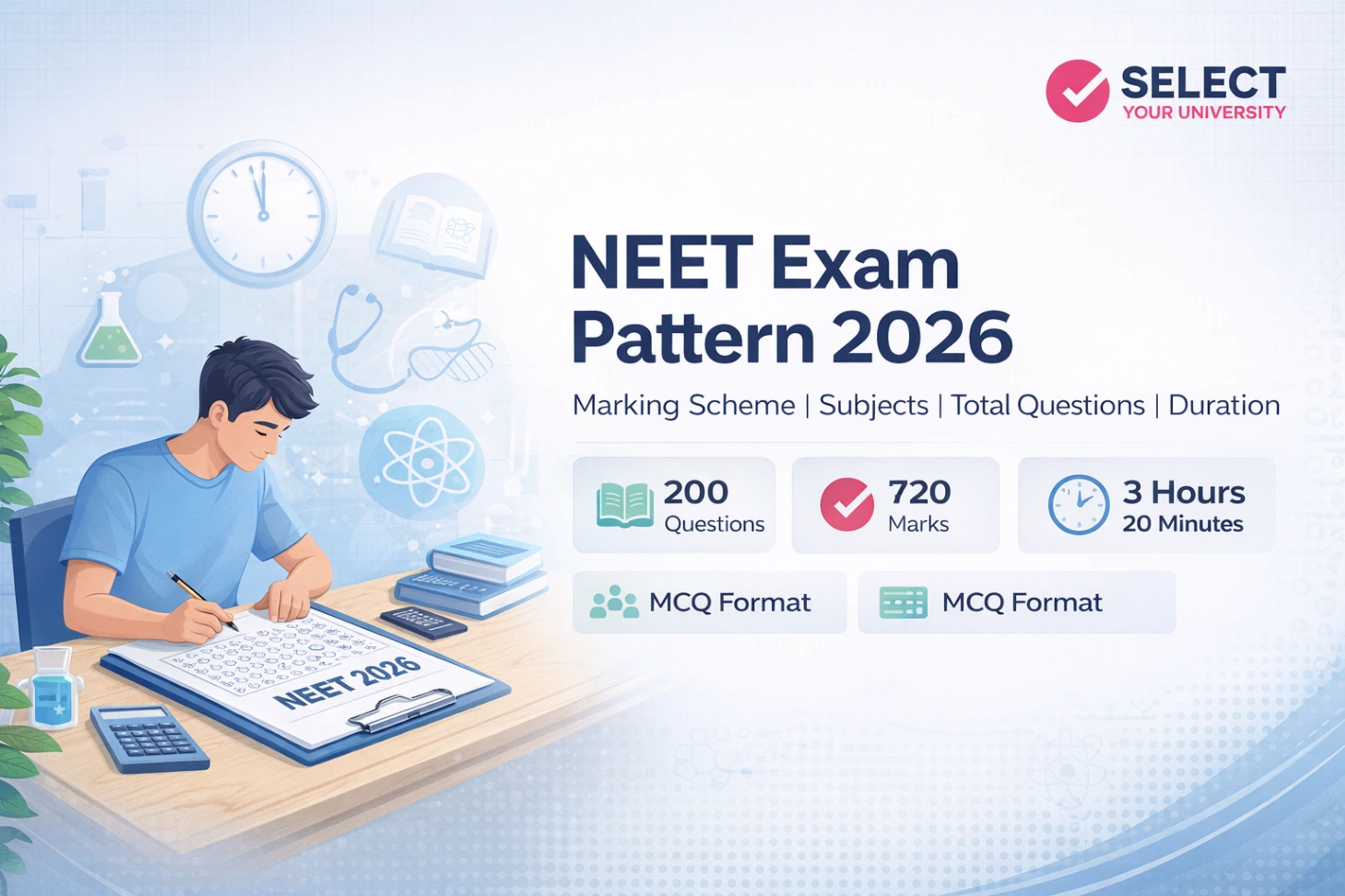 NEET Exam Pattern
The NEET 2026 exam pattern is one of the first things every medical aspirant must understand before beginning serious preparation for one of the most competitive entrance exams in India. MBBS, BDS, AYUSH, and other undergraduate degree courses are available in India and other countries, since some countries rely on the National Eligibility cum Entrance Test (NEET). The pattern of the exam and preparation of the exam, like the methods used to mark the questions, the level of the exam, and how to organize the preparation according to the pattern in order to be sure enough to score high and be in a position to secure a good rank, should really mean a lot.
This in-depth guide on NEET Exam Pattern 2026 explains everything you need to know in detail, including subject-wise weightage, total questions, marking scheme, negative marking rules, section analysis, time management tips, and real student insights, like NEET syllabus 2026, NEET question paper pattern, NEET marking scheme, NEET preparation strategy, NEET practice papers, and NEET exam difficulty level that help you both understand concepts.
Must Read: NEET UG 2026 Registration
☎️ Talk to an Expert Counsellor — FREE Call ☎️ |
|---|
Why Understanding the NEET 2026 Exam Pattern Is Important?
Many contend that before conversing on syllabus topics or attempting practice tests, it is a good idea to understand the NEET UG exam pattern 2026 so as to make good preparation. The exam pattern is used in any form as a guideline to how the question paper should be structured, the number of questions required, the distribution of marks and the time taken, which in this case contributes to help you structure your studying plan better.
By analyzing the pattern:
- You are aware of how many questions you are supposed to get in Physics, Chemistry, and Biology.
- You realize the type of questions (MCQs) that would be asked.
- It is possible to tell the level of difficulty using the past years.
- Time management can be maximized.
- You are allowed to design NEET high-impact study plan 2026.
Other Important Links
NEET 2026 Exam Pattern: Overview
Here is the detailed NEET 2026 Exam Pattern include subjects like Physics, Chemistry, and Biology (Botany + Zoology).
Particulars | Details |
Exam Name | National Eligibility cum Entrance Test (NEET UG) |
Conducting Body | National Testing Agency (NTA) |
Mode of Exam | Pen-and-paper (Offline OMR-based) |
Total Marks | 720 |
Total Questions | 200 (Best of 180 counted) |
Question Type | Multiple Choice Questions (MCQs) |
Duration | 3 hours (180 minutes) |
Subjects | Physics, Chemistry, Biology (Botany + Zoology) |
Marking Scheme | +4 for correct answer, −1 for incorrect answer |
Language | Available in multiple Indian languages (Hindi, English, etc.) |
Exam Frequency | Once a year |
Detailed Section-Wise NEET Exam Pattern
The NEET question paper has been sort of divided into three major parts: Physics, Chemistry, and Biology ( Botany + Zoology ). It is better to know the structure of every section of the plan and organize your time and the topics in order of importance.
Section | Total Questions | Marks | Topics / Subsections | Key Preparation Focus |
Physics | 50 | 180 | Mechanics, Thermodynamics, Electrodynamics, Optics, Modern Physics, Waves & Sound | Requires strong conceptual clarity and mathematical problem-solving skills; regular practice with mock tests and physics problem sets is essential |
Chemistry | 50 | 180 | Physical Chemistry, Organic Chemistry, Inorganic Chemistry | Scoring section if reaction mechanisms, periodic trends, and numerical concepts are revised consistently; inorganic theory needs repeated revision |
Biology | 100 | 360 | Botany and Zoology (Ecology, Genetics, Physiology, Evolution, Human Anatomy) | Highest weightage section; requires deep understanding, memory retention, and frequent NCERT-based revision to maximize score |
Also Read: NEET UG 2026 Syllabus Out: NMC Confirms Updated Curriculum for Medical Aspirants
☎️ Talk to an Expert Counsellor — FREE Call ☎️ |
|---|
NEET 2026 Marking Scheme Explained
NEET 2026 does not have a negative marking rule. It is important to know how marks are given so that you can make sound choices in the exam:
Rule | Marks Awarded |
Correct Answer | +4 marks |
Incorrect Answer | −1 mark |
Unanswered Question | 0 marks |
Grace / Partial Marks | Not allowed |
Total Questions and Time Management
Even though in the NEET 2026 exam there are 200 questions in the paper, 180 can be used as your final score. The other 20 are auxiliary questions that will be utilized during the calibration of exams in the future.
You have 180 minutes to get 180 questions, which is an equivalent of 1 minute per question on average. This lack of time emphasizes the role of time management.
Smart Time Allocation Strategy
Time Block | Suggested Action | Purpose |
First 15–20 minutes | Solve easier Biology questions | Quick scoring and confidence boost |
Next 50–60 minutes | Attempt easier Chemistry questions | Secure marks from scoring section |
Remaining time | Focus on Physics and difficult questions | Tackle numericals and high-value problems |
Last 10–15 minutes | Review marked answers and fill blanks | Error correction and accuracy improvement |
Also Read: Aadhaar-Based Identity Checks and Live Photo Requirement Introduced for NEET UG 2026 Applicants
NEET 2026 Language Medium and Localization
When registering for NEET 2026, the choice of language in which you feel comfortable in terms of comprehension should be taken, and this will save you confusion on the exam day. Most learners use their regional or native language in order to learn complex passages in biology.
NEET 2026 is provided in various languages to assist learners throughout the country. The examination is normally offered in:
- English
- Hindi
- Gujarati
- Marathi
- Tamil
- Telugu
- Kannada
- Assamese
- Bengali
- Urdu
Difficulty Level of NEET Questions
NEET past years' comparative analysis has indicated that Biology always provides most number of questions that have easy-to-medium answers, hence it becomes one of the most scoring sections whenever it is prepared adequately. Although the number of difficulties can change annually, the overall tendency is the following:
Section | Difficulty Level |
Biology | Easy to Moderate |
Chemistry | Moderate |
Physics | Moderate to Difficult |
Also Check | |
Breakup of Sectional Weightage
The information enables you to determine the best time to spend on books in order to achieve good NEET marks. Knowledge of topic distribution can assist in the formation of a specific preparation plan for NEET 2026:
Subject | High-Weightage Topics |
Biology (Most Weightage) | Genetics & Evolution; Human Physiology; Plant Physiology; Ecology; Diversity |
Chemistry | Organic Reaction Mechanisms; Periodic Table; Chemical Bonding; Coordination Compounds; Biomolecule Chemistry |
Physics | Mechanics & Laws of Motion; Modern Physics; Work, Energy & Power; Electricity & Magnetism; Waves & Oscillation |
How to Prepare Based on the NEET Exam Pattern?
The preparation of NEET 2026 is not just in terms of quantity but also in terms of quality. The following is a good study plan designed by exam pattern:
Strategic one-on-one Preparation
- The strategy will help you plan your preparation based on the blueprint of NEET exam.
- Get used to NEET syllabus: Revise NEET syllabus 2026 and emphasize high-weightage topics.
- Foundational Work: Starting with NCERT textbooks and moving on to higher / coaching work.
- Periodical Mock Tests: Mock tests with the NEET pattern should be used weekly.
- Lesson to learn: When a person is wrong, examine what has caused the mistake, and learn not to avoid understanding.
- Rule Review: Biology needs to be reviewed either on a regular basis or by prescribed review dates.
- Practice: Silence Practice: In practice, this is when you are asked to practice at simulated full-length tests, you are expected to complete faster and more accurately than others.
- Section-Wise Focus: With the weak areas you have in the morning, pay very close attention to them.
Best Resources for NEET 2026 Preparation
Choosing the right study material for NEET 2026 is as crucial as understanding the pattern:
- NCERT Biology textbooks
- NCERT Chemistry textbook + reference books
- Physics concept books + numerical practice sets
- Online test series and NEET mock papers
- Previous year question papers
Importance of Full-Length Mock Tests
Mock tests also replicate a pattern of the actual NEET question paper. A majority of toppers prescribe a minimum of 60-80 mock tests before a final exam.
They help you:
- Test performance under the conditions of real exams.
- Enhance time allocation and speed.
- Identify weak topics early
- Track progress over time
How NEET Section Strategy Can Boost Your Score?
This NEET Section-wise strategy can help you to win more marks and reduce stupid mistakes. A planned course of action enhances precision and decreases tension:
- First change to Solve Biology, then that is your best subject.
- Give importance to easy and scoring questions.
- Highlight tough questions to look at.
- There is negative marking, and hence, avoid guesswork.
NEET Exam Day: Pattern & Practical Tips
Relaxation in the examination hall is also an essential factor in the sense that you will get negative points once you get panicked and cannot resist the temptation of giving out answers just through sheer guesses. Everything needs to be answered in a coherent and stable mind without being scared by the stress. The familiar persons with the NEET exam pattern 2026 perform well because they have the information on how to allocate time and energy on the paper.
Important exam-day tips:
- Go to the exam center early so that you are not stressed with delays or long queues during verification.
- Keep your admit card, valid ID proof, and other required documents in a well-packaged folder.
- Note-taking should never be done at the last minute, as this is very disorienting and not helpful.
- Carefully read through every question, then pick an option.
- Go with option elimination since it would work to make the guess more accurate.
- Do not take too much time on one hard question - come back to it later.
- Learn to maintain consistent timekeeping and not to panic.
- Read through the responses under the review question in the last few minutes and answer the gaps rationally.
NEET Exam Pattern 2026: Trends From Previous Years
The old test papers of NEET exam represent a nice mix of easy, average, and difficult questions, actually, which the National Testing Agency designed to test on knowledge and not on chance. The same concepts are repeated every year somehow or the other and hence it becomes very effective to solve the papers and mock tests of last year. The students learn in advance what kind of questions to expect during their examinations, the students are able to manage their time, and the students handle the examinations in the hall with confidence and not trepidation, as per the trends of the exams. Conventionally, NEET has been results-based, and failure deviations do not matter:
- The highest score is still in biology.
- Physics is usually used to differentiate the top rankers.
- Revision and remembering is compensated by chemistry.
Final Thoughts on NEET 2026 Exam Pattern
The NEET 2026 exam pattern is a well-structured evaluation system designed to assess conceptual understanding, analytical ability, and scientific aptitude across Physics, Chemistry, and Biology. Good understanding of the trend and also repetitive practice, wise revision and time bound mock can significantly boost the chances of success in the form of high rank and medical seat.
And whether you have to become All India Rank, state quota or even campus preference, get the pattern right, and you are on the first step of achieving your dream of becoming a doctor.
☎️ Talk to an Expert Counsellor — FREE Call ☎️ |
|---|
NEET 2026: FAQs
Ques. What is the exam pattern of NEET 2026?
Ans. The NEET 2026 paper will also take the same format as it has in the previous years, with sections of Physics, Chemistry, and Biology. It will be multiple choice quiz based and time-matched across the subjects with negative marking.
Ques. Which section is the most scoring in NEET?
Ans. The weight of biology is the highest, and it is regarded as the most scoring section. Good revision when studied at NCERT can greatly increase your total marks.
Ques. Does NEET exam pattern change every year?
Ans. Patterns of the National Eligibility cum Entrance Test do not change radically. Variations of difficulties are minimal; thus, previous papers remain very useful.
Ques. Is Physics the toughest part of NEET?
Ans. The nature of Physics makes it moderately to difficult for several students as it involves calculations and concepts. Both speed and confidence are improved with occasional number practice.
Ques. How important are previous year papers for NEET?
Ans. The past articles can make you learn trends, the style of questioning, and time management. They decrease the fear of exams and enhance precision.