




CAT Exam 2026 Eligibility, Syllabus & Preparation Strategy
Common Admission Test
CAT 2026 Eligibility Criteria
The CAT 2026 eligibility criteria requires a bachelor's degree with a minimum of 50% aggregate from a recognized university, or an equivalent qualification. Final-year students are also eligible to apply for the CAT 2026 exam, provided they can submit proof of graduation by the specified deadline. Candidates from any discipline can apply, and there are no restrictions based on gender, nationality, or work experience. It is important for applicants to ensure that they meet the eligibility criteria before filling out the application form.
Common Admission Test
CAT 2026 Eligibility
The table below further describes the CAT 2026 eligibility criteria in a detailed way.
Parameters | Details |
Educational Qualifications | A bachelor's degree (or equivalent) from a recognized university is required. Candidates must have secured a minimum of 50% (45% for SC/ST/PwD) marks or equivalent CGPA in their bachelor's degree. |
Professional Degrees | Students who have completed professional degrees like CA/CS/ICWA/FIAI are also eligible to appear for the CAT exam, provided they meet the minimum percentage requirement. |
Age Limit | There is no upper age limit. |
Common Admission Test
CAT 2026 Exam Syllabus
The CAT 2026 exam syllabus includes a total of 3 sections, i.e., Verbal Ability and Reading Comprehension, Data Interpretation and Logical Reasoning, and Quantitative Ability. The table below shows the CAT 2026 exam structure and pattern.
Particulars | Details |
Mode | Computer-Based Test |
Duration | 120 Minutes |
Question Types | Multiple Choice (MCQ) and Type-In-The-Answer (TITA) |
Marking Scheme | +3 marks for correct, -1 mark for incorrect MCQs, no negative for TITA |
Language | English |
Scoring | Percentile-based ranking |
CAT Syllabus 2026
The table below shows the detailed syllabus for CAT 2026.
Section | Key Topics & Sub-Areas (expected) |
VARC | Reading Comprehension (RC): Passages of diverse genres, inference, main idea, tone. |
Verbal Ability: Paragraph completion, jumbled paragraphs, para-summary, grammar, vocabulary, sentence correction. | |
DILR | Data Interpretation: Tables, graphs, charts, Venn diagrams, case lets, data sufficiency. |
Logical Reasoning: Sets, arrangements, puzzles, sequences, games, binary logic. | |
QA | Arithmetic: Percentages, profit & loss, averages, ratio & proportion, time-speed-distance, interest, mixtures. |
Algebra: Equations (linear, quadratic), inequalities, functions, progressions, logs. | |
Geometry: Triangles, circles, polygons, coordinate geometry, mensuration. | |
Number Systems: Integers, divisibility, LCM & HCF, bases, factors | |
Modern Math: Permutations & combinations, probability, set theory. |
CAT 2026 Exam: Section-Wise Weightage
The following table shows the CAT 2026 section-wise weightage.
Section | No. of Questions | Marks | Time (min) |
Verbal Ability & Reading Comprehension | 24 | 72 | 40 |
Data Interpretation & Logical Reasoning | 22 | 66 | 40 |
Quantitative Aptitude | 22 | 66 | 40 |
Common Admission Test
CAT 2026 Preparation Tips
The CAT exam is a top management entrance exam in India. The exam allows you to secure admission to top B-schools in the country. The CAT exam comprises 3 sections: VARC, DILR, and Quantitative Aptitude. Each sub-section requires extensive preparation.
As per SYU expert analysis, the difficulty level for CAT 2026 exam can be expected to be medium to difficult. The exam is tentatively scheduled to be held on 29 November 2026.
CAT Preparation Strategy 2026
Students may opt for a coaching centre or prepare on their own for the CAT exam 2026. The following are some toppers’ strategies for the exam:
- Understand the CAT Exam Syllabus 2026 and identify your weaker topics.
- Familiarize yourself with the CAT Exam Pattern 2026 and plan your preparation accordingly.
- Collect the best CAT Exam books recommended by experts, along with all required study material.
- Stick to your prep strategy consistently. Consistency is key to cracking the exam.
- Record your progress and focus on improving your weak areas.
How to Prepare for the CAT Verbal Ability and Reading Comprehension Section?
Key tips to boost your CAT Exam VARC preparation:
- Read from diverse and challenging sources daily.
- Focus on mastering Reading Comprehension, prioritizing accuracy over speed.
- Sharpen logical skills for para-jumbles and summary questions.
- Analyze every mock test in-depth to identify and correct errors.
- Build vocabulary naturally by learning words in context while reading.
How to Prepare for the CAT Data Interpretation and Logical Reasoning Section?
Key tips to boost your CAT Exam DILR preparation:
- Solve at least four different types of DILR sets daily to build familiarity.
- Master rapid calculation techniques and approximations for data interpretation.
- Learn to quickly categorize and select the right sets to attempt during the exam.
- Develop a systematic approach for visualizing information using tables or diagrams.
- Analyze mock tests thoroughly to improve set selection strategy and accuracy.
How to Prepare for the CAT Quantitative Aptitude Section?
Key tips to boost your CAT Exam QA preparation:
- Master the fundamentals of arithmetic, algebra, and geometry before tackling complex problems.
- Solve a variety of problems daily, focusing on understanding the 'why' behind each solution.
- Learn shortcuts and mental math tricks to increase calculation speed and save time.
- Take regular topic-wise tests to identify and strengthen weak areas systematically.
- Prioritize round-one questions in mocks to maximize attempts and build your score strategically.
Common Admission Test
Latest News

CAT 2026 Exam Day Tips: Time Management, Strategy & Do’s and Don’ts
Shreshtha Mishra • 1 Mins read • 21 Oct 26

CAT Last Minute Preparation 2026: 8 Expert Tips, Revision Strategy & Mistakes to Avoid Before Exam
Pragati Srivastava • 1 Mins read • 20 Oct 26

CAT Admit Card 2026: Release Date, Download Link & Steps
Srijita Saha • 1 Mins read • 20 Oct 26

CAT 2026 Registration Closes on September 15: Apply Online, Fee, Eligibility & Exam Date
Shreyosee • 1 Mins read • 6 Sep 26
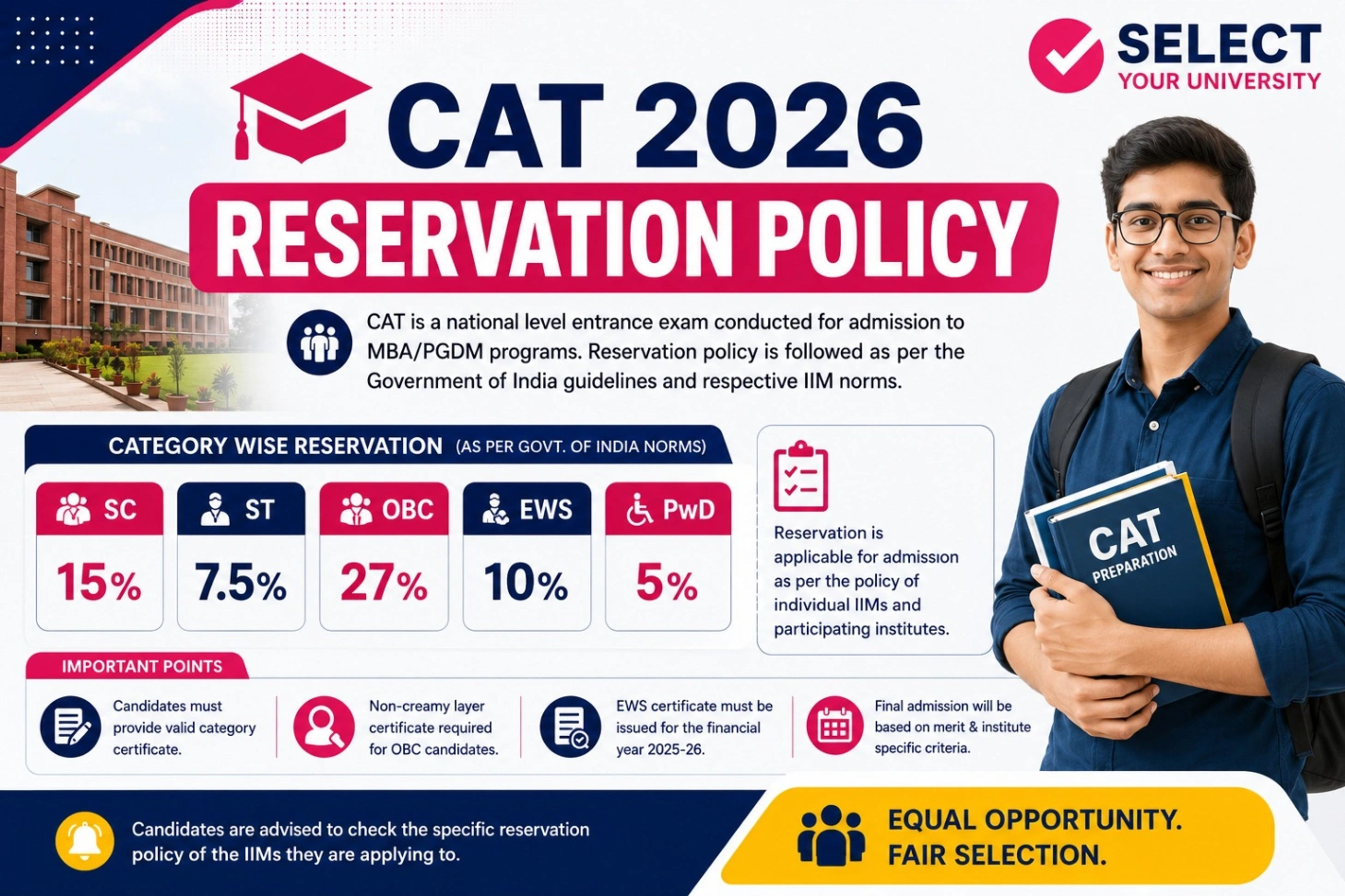
CAT 2026 Reservation Policy: Category-Wise Reservation, Eligibility, Documents & Rules
Shreyosee • 1 Mins read • 1 Sep 26

CAT 2025 Answer Key Live: Slot-Wise PDFs and Response Sheets Available
Pragati Srivastava • 1 Mins read • 11 Dec 25

CAT 2025 Mock Test Link Activated: Check Exam Date, Admit Card & How to Access
Jyoti • 1 Mins read • 13 Nov 25

CAT 2025 Exam Day Dos and Don’ts: Important Instructions, Guidelines, and What to Carry
Srijita Saha • 1 Mins read • 27 Nov 25
Common Admission Test

Not sure what you are looking for? Connect with our counsellors.
Login helps you find curated results for your requirement.