



How to Get Admission in MBBS in Government College 2026: Eligibility, NEET, Counselling & Admission Process
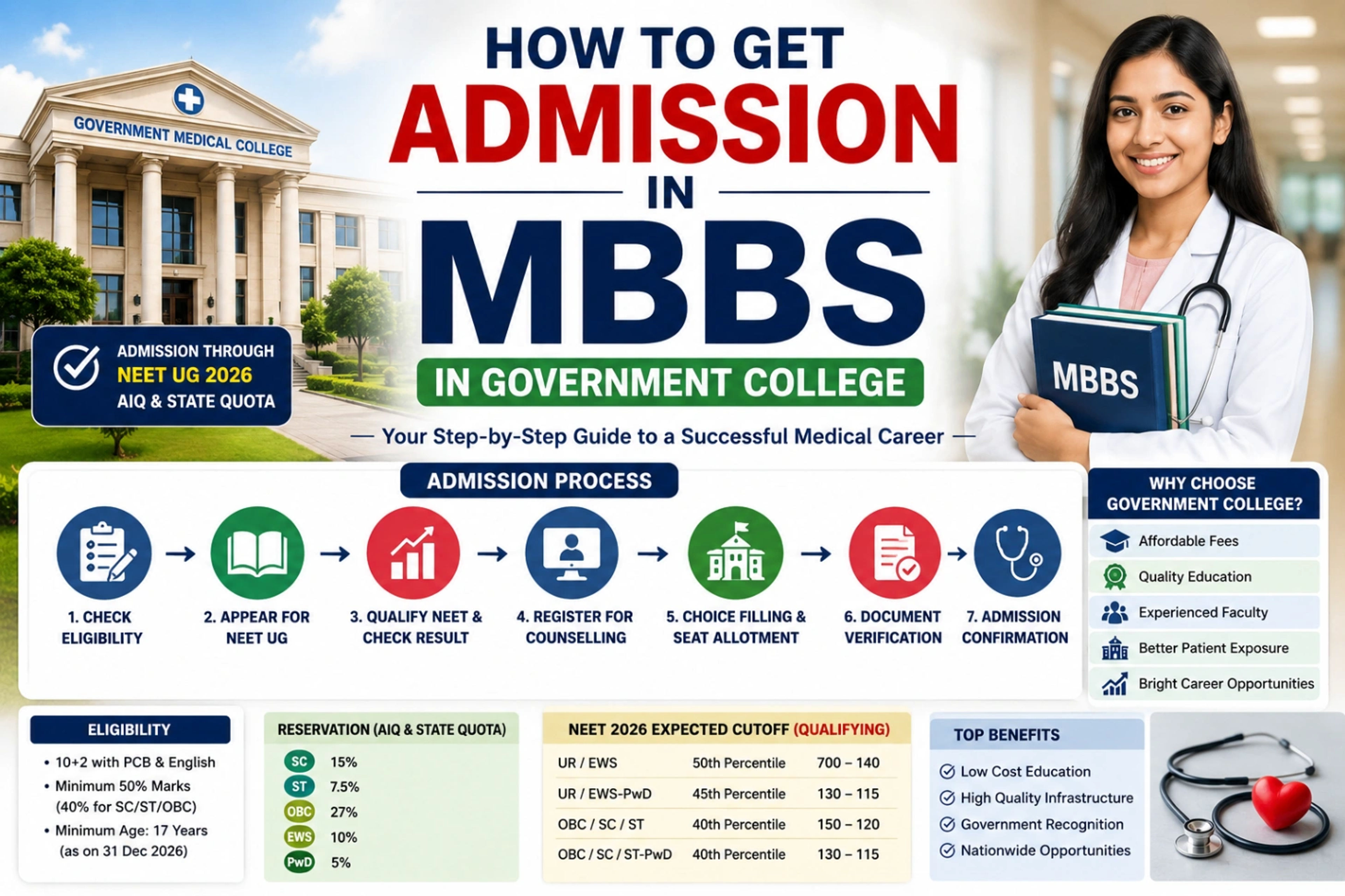 How to Get Admission in MBBS in Government College
Latest Updates:
- NEET UG Re-Exam Analysis 2026: Physics Toughest, Overall Paper Rated Moderate. Click Here.
- NEET Rank Predictor 2026: Predict Rank by Marks & Find MBBS Colleges. Click Here.
- NEET Cutoff for Government Colleges 2026 (Expected) – MBBS Safe Score, AIIMS & JIPMER Cutoff. Click Here.
- Top Government Medical Colleges in India for MBBS 2026. Click Here.
- Total MBBS Seats in India 2026: State-Wise Seat Matrix, Government & Private Colleges. Click Here
Thinking of how to get admission in MBBS in government college? The MBBS admission process in a government medical college includes a centralized counselling process that is conducted by the Directorate General of Health Sciences (DGHS) on behalf of the Medical Counselling Committee (MCC) for 15% AIQ seats and state authorities conduct the remaining 85% State Quota seats in the government medical colleges. The scores obtained by applicants in the NEET UG exam are utilised for admission to 15% AIQ and 85% State Quota MBBS seats in government colleges.
This blog will help you understand the ways to take MBBS admission in a government college.
Read More:
- Government Medical Colleges Accepting Low NEET Score 2026
- Top Medical Colleges Accepting NEET Scores in East and West India 2026
- 170 Marks in NEET 2026: Expected Rank, Percentile & MBBS Admission Chances
- Top Colleges Accepting NEET UG Scores in North India for MBBS
- Colleges Accepting NEET UG Scores for MBBS Admissions in South India 2026
How to get admission in MBBS government college: Entrance Exams
In India, admission to both government and private medical colleges for MBBS is determined through the marks obtained in the National Eligibility cum Entrance Test (NEET). The National Testing Agency (NTA) conducts this national-level exam, which evaluates your understanding of Biology, Chemistry, and Physics based on your 10+2 syllabus.
Read More: How to Prepare for NEET Exam
NEET Syllabus
The NEET syllabus is based on the NCERT syllabus of classes 11 and 12 and covers topics from Physics, Chemistry, and Biology. It is important to thoroughly prepare for the exam to secure a good score and get into your favorite government institute. Check out the main topics for each section in the table below.
Subject | Topics |
Physics | Physical world and measurement, Kinematics, Laws of Motion, Work, Energy, Magnetic Effects of Current and Magnetism, Electromagnetic Induction and Alternating Currents, Electromagnetic Waves, Optics, Atoms and Nuclei, etc. |
Chemistry | Physical Chemistry - Atomic Structure, Chemical Bonding and Molecular Structure, Chemical Thermodynamics, Equilibrium, etc. Organic Chemistry includes topics such as Hydrocarbons. Inorganic Chemistry - p-Block Elements, d- and f-Block Elements, Coordination Compounds, Aldehydes, Ketones and Carboxylic Acids, Biomolecules, etc. |
Biology | Diversity in the Living World, Cell Structure and Function, Plant Physiology, Human Physiology, Reproduction, Biotechnology and Its Applications, etc. |
How to get admission in MBBS in government college?
To get admission to MBBS in a government college, candidates can follow the steps below:
- Step 1: Fill out the NEET application form that is available in online mode.
- Step 2: Appear for the NEET UG exam, which is the single undergraduate-level medical entrance exam.
- Step 3: The NEET question paper includes 200 multiple-choice questions from Chemistry, Biology and Physics, out of which the students have to answer 180 questions.
- Step 4: The NTA declares the NEET result and the final answer key, and applicants who obtain the category-wise minimum qualifying percentile are eligible for MBBS admission in the medical colleges of India.
Check:
- Re-NEET State Wise Rank List 2026 (Out Soon): PDF Download, Merit List & Counselling Updates
- Minimum Marks Required in NEET for MBBS in Government College
MBBS admission process in government colleges under 15% All India Quota
The medical candidates who clear the NEET exam and get shortlisted under the 15% All India Quota must register themselves for the counselling process. The schedule for NEET UG counselling is published by MCC on the official website.
How to get admission in Government MBBS College: NEET Counselling Registration
To get admission to MBBS in a government college under the 15% AIQ scheme, eligible medical candidates have to register themselves for the seat allotment process after downloading the NEET rank letter. Applicants must enter the registration details mentioned below:
Step 1: Visit the official website (mcc.nic.in)
Step 2: Select ‘New Registration’ tab and then enter the details such as:
- Roll number
- Candidate's name
- Application number
- Date of birth
- Email ID
- Mother’s name
- Mobile number
- Security pin shown on the screen
Step 3: After the new registration process is complete, applicants get a mail on the registered email ID that mentions successful registration along with their password.
Step 4: Through the use of the login credentials received, log in and then enter the NEET UG details.
Step 5: Make the application fee payment through the available options.
Medical candidates have to first complete the registration process and then fill as well as lock in their choices of courses and colleges. After this, the MBBS admissions in the government colleges are granted depending on the NEET All India Rank (AIR), college preferences and courses submitted, availability of seats, reservation criteria, etc.
After the authorities publish the seat allotment list, chosen candidates must either accept the college or choose to appear in the following counselling rounds. Medical candidates who select to accept the allotted college must report to the institute for verification of documents and complete the other admission processes. After the conclusion of the 1st counselling round, the authorities conduct 2nd counselling for remaining seats.
After the completion of first and second counselling rounds, applicants must note that DHGS on behalf of the MCC transfers remaining surrendered or vacant seats to respective state counselling authorities for MBBS admission to the government colleges under the 85% state quota seats.
Don’t Miss: NEET UG Counselling 2026: Registration, Schedule, Eligibility, Fees, Cutoff & Seat Allotment
Admission in MBBS in Government Colleges under 85% State Quota
Apart from 15% AIQ seats; under the state quota seats, the remaining 85% seats are covered in all the government medical colleges. Admission to MBBS in government colleges of each state is granted to the applicant who is a domicile of that state. Candidates have to fulfill the basic eligibility criteria that are equalised among all the states to get admission to a government medical college. As mentioned by state counselling authorities, candidates must fulfill the qualification and domicile requirements.
Re-NEET Expected Qualifying Percentile and Qualifying Cutoff
The table below shows the qualifying percentile and qualifying cutoff related to Re-NEET 2026.
Category | NEET Cutoff 2026 Percentile | NEET 2026 Expected Cutoff Score |
UR or EWS | 50th | 700-140 |
UR or EWS-PwD | 45th | 130-115 |
OBC, SC, ST | 40th | 150-120 |
OBC/SC/ST-PwD | 40th | 130-115 |
- NEET Cutoff 2026 (Expected): Category-Wise Cutoff, Government College Cutoff, Marks vs Rank & Safe Score
- NEET Expected Cut-Off 2026 for Government, Private & AIIMS MBBS Colleges
MBBS admission in government college: 85% State Quota
Applicants who look for admission to MBBS in government medical colleges have to first qualify for NEET and fulfill respective state counselling registration forms. The state authorities normally conduct 3 counselling rounds that involve a mop-up round for the vacant seats.
Eligible medical candidates must fill in their personal and educational qualifications, etc. Depending on the scores obtained in the NEET exam, the state merit list is prepared by authorities that contains details such as state rank and AIR.
The state merit list is utilised to grant admissions to government colleges. A seat allotment process for the state quota is conducted by the authorities after the completion of the counselling process. The seat allotment process for the government college MBBS admission is done online in some states and offline in other states.
How to get admission in MBBS in government college: Eligibility Criteria
Before you think about taking admission to an MBBS course. It is important to make sure that you meet the basic eligibility criteria. These include the following.
- Age Limit - You must be at least 17 years old as of December 31st in the year of admission.
- Educational Qualifications - You should have completed your 10+2 (or equivalent) with Physics, Chemistry, Biology, and English as core subjects.
- Minimum Marks - You must have obtained a minimum of 50% in aggregate in these subjects for general candidates. For SC/ST/OBC candidates, the minimum requirement is usually 40%, and for PwD candidates, it’s 45%.
- Nationality - Indian citizens, Overseas Citizens of India (OCI), and Non-Resident Indians (NRIs) are eligible to apply for the NEET exam and for admission to MBBS courses in government colleges.
How to get admission in MBBS in government college: Reservation Policies
Government medical colleges in India follow specific reservation policies to ensure equal opportunities for all eligible students. While the All India Quota (AIQ) seats are allotted centrally, the State Quota seats are managed by the individual states, and they may have their own additional reservations, such as for rural areas, women, and other specific groups. Below are the common reservation categories along with an overview of the reservation percentage.
Category | Reservation Percentage |
SC | 15% |
ST | 7.5% |
OBC | 27% |
EWS | 10% |
PwD | 5% (of total seats) |
How to get admission in MBBS in government college: Top Government Colleges by State
Below is a list of some of the top government medical colleges in India, categorized by state. This will give you a clear picture of where to focus your NEET preparation, helping you aim for the best colleges in the country.
NIRF Rank | Name of Institute | City |
1 | New Delhi | |
2 | Post Graduate Institute of Medical Education and Research | Chandigarh |
3 | Vellore | |
4 | National Institute of Mental Health and Neuro Sciences, Bangalore | Bengaluru |
5 | Jawaharlal Institute of Postgraduate Medical Education and Research | Puducherry |
6 | Lucknow | |
7 | Varanasi | |
8 | Coimbatore | |
9 | Manipal | |
10 | Madras Medical College and Government General Hospital, Chennai | Chennai |
How to get admission in MBBS in government college: State Quota Reservation Details
In India, medical colleges under government management follow a specific reservation policy for residents of the state where the local students are given preference in the allocation of seats. The state quota typically covers 85% of the total MBBS seats in most government medical colleges, while the remaining 15% of the seats fall under the All India Quota (AIQ). To be eligible for state quota seats, you usually need to be a domicile of that state. This could mean you either completed your schooling there or have lived in the state for a certain number of years. Each state has its own criteria, so it’s important to check the requirements for your particular state. The state quota is divided into different categories, which can really affect your chances of getting a seat.
The General (Unreserved) category typically gets around 50% of the state seats. In addition, there are reserved seats for SC, ST, OBC, and EWS categories. PwD candidates also get 5% of the seats. Some states even offer extra seats for rural candidates and women. So, if you’re aiming for a government college in your state, it is important to understand the reservation policies and make sure you meet the eligibility requirements. Take a look at the state quota reservations for a few states below.
Name of the State | State Reservation Quota |
Delhi | 85% |
Maharashtra | 85% |
Tamil Nadu | 85% |
Uttar Pradesh | 85% |
West Bengal | 85% |
How to get admission in MBBS in government college: Key Takeaways
In conclusion, getting admission to an MBBS program at a government medical college in India is both a rewarding and challenging journey. It’s not just about acing the NEET exam but also understanding the entire process, from eligibility criteria to counselling procedures. It’s crucial to have a clear grasp of state quotas and reservation policies to better align your goals and plan your next steps.
The journey isn’t easy and there’s a lot to balance with preparation, managing stress, etc. But if you follow the above steps, stay committed, and remain patient with the process, your chances of securing a seat in one of India’s prestigious medical colleges can significantly improve. As a medical aspirant, you must stay determined with a positive mindset and focus on getting admission to top MBBS government colleges in India.
How to get admission in MBBS in government college: FAQs
Ques: How to get admission in government medical college with NEET?
Ans: The factors that influence the medical college admission of students with NEET are given below:
- NEET 2026 rank as well as marks.
- Chosen course (MBBS/AYUSH/BDS/other)
- Expected cutoff trends for 2026.
- College Type (government, private, central, deemed)
- Location as well as state domicile benefits.
- College fees, internship, facilities, and placement history.
Ques: What is the minimum NEET score needed for MBBS in government college?
Ans: To obtain a government MBBS seat, NEET qualification is not sufficient as candidates have to fulfill the actual admission cutoff. While the general candidates normally need a range of 615 and 630+ marks, reserved categories require lower scores.
Ques: How do candidates get admission in MBBS?
Ans: Getting admission into the MBBS program needs completion of Class 12 with Chemistry, Physics and Biology, qualifying the standardized national medical entrance exam as well as successfully navigating the centralized counselling process.
Ques: Can any student get into government medical college without NEET?
Ans: No, no government medical college can grant admission to students for the MBBS course without getting qualified for the NEET exam. Under the regulations of National Medical Commission, NEET is the compulsory entrance gateway for all the medical and dental programs in India.
Ques: Was the Re-NEET 2026 exam easy?
Ans: No, the Re-NEET 2026 exam was moderate to tough, in which the Biology and Chemistry sections were typically straightforward and heavily based on NCERT; however, the Physics section was lengthy and also time-consuming.