


How to Get Admission in MBBS in Private College 2026: Eligibility, Fees, Admission Process & Top Colleges
 How to Get Admission in MBBS in Private College
Latest Updates
- NEET Answer Key 2026 has been published. Click here
- NEET 2026 Answer Key Allen is out after re-NEET 2026. Click here
- Akash's re-NEET answer key is also out. Click here
- Re-NEET 2026 result is expected to be published by July 20, 2026. Click here
“How to Get Admission in MBBS in Private College” is the main concern among students who are unable to take admission to government medical colleges in India. Candidates need to qualify for the re-NEET 2026 exam along with passing their 10+2 exam with a minimum of 50% marks to secure MBBS admission in private medical colleges in India. In the 10+2 exam, they need to have the subject stream of Physics, Chemistry and Biology.
Private medical schools offer a great alternative for students who might not be able to get a seat at government institutions. However, it takes considerable preparation, understanding of the requirements, and adequate finances to get admission to a private medical school. The advantages, qualifying requirements, admissions procedure, and a thorough cost comparison will all be covered in this blog on how to get accepted into a private college for MBBS.

Don’t forget to read:
- MBBS Fees Structure in India: Government vs Private Colleges 2026
- Re-NEET 2026 Exam Analysis
- MCC AIQ Counselling 2026 Expected to Be Delayed After NEET UG 2026 Cancellation
- Re-NEET 2026 Impact on MBBS Cutoff: Will NEET Cutoff Go Higher or Lower?
- NEET 2026 Rank Inflation After Re-Exam: Will Cutoffs Rise for MBBS Admissions?
- NEET BDS Cut Off
- Top Colleges Accepting NEET in North India
- Colleges accepting NEET in South India
- Top Medical Colleges Accepting NEET Scores in East and West India 2026
Benefits of Private Medical Colleges
Private medical colleges offer several advantages over government colleges in a few departments. Check out some benefits below:
1. Higher Availability of Seats
Government medical colleges have only limited seats, making the competition extremely tough and making it more stressful. Private colleges have more seats available and carry a lower cutoff compared to govt. colleges, increasing the chances of admission and ensuring that students don’t waste their years on multiple attempts.
2. Better Infrastructure and Facilities
Private medical colleges are often well-funded and provide good facilities, including modern laboratories, well-equipped hospitals for clinical training, and advanced medical equipment.
3. Flexible Admission Criteria
While government colleges have strict merit-based selection, private colleges offer more flexibility. Some private institutions accept students with slightly lower NEET (National Eligibility cum Entrance Test) scores and some even accept management seats.
4. Quality Education and Faculty
Private universities guarantee that students receive a good education and practical experience by employing highly qualified faculty members and offering specialised medical training.
5. International Collaborations
Some private medical colleges collaborate with foreign universities, offering exchange programs and global exposure, which can be beneficial for students aspiring to work or study abroad.
Read More: Top 15 MBBS Colleges in Maharashtra (Government & Private)
Fees and Eligibility for MBBS in Private Colleges
Eligibility Criteria for MBBS Admission in Private Colleges
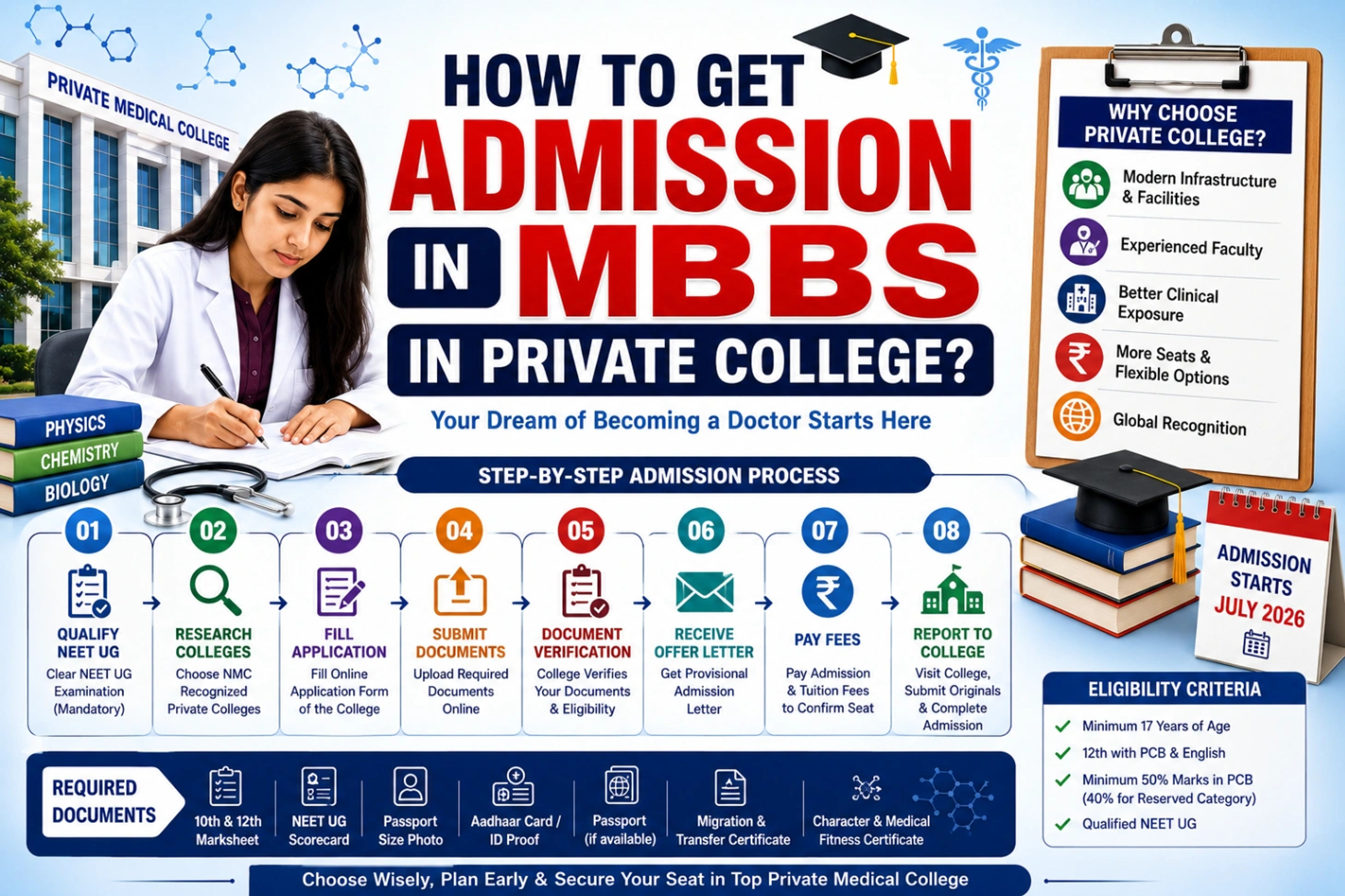
To secure admission to an MBBS course in a private college, candidates must fulfil certain eligibility criteria. However, you should keep an eye out for specific requirements as some institutes might have additional requirements. Below are the most common requirements:
- Educational Qualification: The candidate must have completed 10+2 with Physics, Chemistry, and Biology (PCB) as core subjects.
- Minimum Marks: Most colleges require at least 50% marks in PCB for general category students and 40% for reserved categories (SC/ST/OBC).
- NEET Qualification: It is mandatory to qualify for the NEET exam as per the guidelines of the National Medical Commission (NMC).
- Age Requirement: The minimum age requirement is 17 years at the time of admission, with no upper age limit as per the latest NMC regulations.
- Domicile Requirements: Some private colleges have specific state domicile requirements, while others accept students from all over India.
Fee structure of Private Medical Colleges
The cost of studying MBBS in a private medical college is significantly higher than in government colleges. The fees vary based on the college's reputation, infrastructure, and location. Apart from tuition fees, students also need to take hostel charges, books, lab fees, and miscellaneous expenses into account. Students should explore education loans, scholarships, and financial aid options to ease the financial burden.
Below is a comparison of MBBS fees in some well-known private colleges:
College Name | Location | Approximate Fees (Per Year in INR) |
Manipal | ₹14,00,000-₹18,00,000 | |
Vellore | ₹3,00,000-₹5,00,000 | |
SRM Medical College | Chennai | ₹20,00,000-₹25,00,000 |
Amrita School of Medicine | Kochi | ₹15,00,000-₹18,00,000 |
DY Patil Medical College | Pune | ₹25,00,000-₹30,00,000 |
Admission Process for MBBS in Private Colleges
The admission process for MBBS in private medical colleges follows a structured approach. Below are the key steps involved:
Steps | Description |
1 | The first and most crucial step for MBBS admission is qualifying for NEET-UG (National Eligibility cum Entrance Test), which is mandatory for all medical aspirants in India. A high NEET score increases your chances of securing a seat in a reputed private medical college at a lower fee. |
2 | Register for the centralised counselling process conducted by the state or national authorities. |
3 |
|
3 | Attend document verification and confirm seat allotment. |
4 | Pay the required fees and complete the admission formalities. |
Detailed Admission Process
1. Qualify NEET Exam
- NEET is the only entrance exam for MBBS admissions in India.
- The exam consists of Physics, Chemistry, and Biology with a total of 720 marks.
- The cutoff varies each year depending on competition and difficulty level.
2. Participate in NEET Counseling
- Admissions to private medical colleges are conducted through All India Quota (AIQ) or State Quota.
- Candidates must register on the Medical Counseling Committee (MCC) website for AIQ seats.
- For state quota seats, candidates must apply through their respective state counselling authorities.
3. Choice Filling and Seat Allotment
- Based on the NEET score and preferences, students can select their desired colleges.
- The seat allotment process is conducted in multiple rounds.
4. Document Verification
- Candidates need to submit the following documents during verification:
- NEET Admit Card and Scorecard
- Class 10 and 12 Mark Sheets
- Identity Proof (Aadhaar/PAN/Passport)
- Domicile Certificate (if applicable)
- Caste Certificate (for reserved category candidates)
5. Payment of Fees and Admission Confirmation
- Once the seat is allotted, candidates must pay the fees to confirm admission.
- Failure to pay fees within the stipulated time may lead to the cancellation of the seat.
Advantages of Studying MBBS in Private Colleges
The table below portrays the details of the advantages of studying MBBS in private medical colleges in India.
Advantages | Description |
More Seat Availability | Private colleges offer a larger number of MBBS seats compared to government institutions and lower cut-offs make sure that you get your preferred institute. |
Modern Infrastructure | Private colleges often have better-equipped laboratories, infrastructure and hospitals. |
Specialized Medical Training | Many institutions provide specialized training and international exposure via exchange programs. |
More Faculty Attention | Smaller class sizes ensure better teacher-student interaction and students can learn better. |
Opportunities for Management Quota | Students with lower NEET scores can still secure admission through the management quota (higher fees apply). |
Substitute Options for Indian students to study MBBS
Students who are unable to meet the MBBS eligibility criteria for private Medical colleges in India can look forward to study MBBS abroad. The table below highlights the options for Indian students to study MBBS abroad.
MBBS Abroad 2026-27 | ||
Top Medical Colleges in the World 2026-27
Many Indian students opt for studying MBBS abroad because of their inability to take admission in private medical colleges in India. The table below lists some of the top medical colleges in the world that are popular among Indian students. Check: Top 100 Medical Colleges in the World 2026.
Top Medical Colleges in World 2026-27 | |
Al-Farabi Kazakh National University | |
Caspian International School of Medicine | |
Conclusion
Private medical colleges provide modern laboratories, well-equipped hospitals for clinical training, and a structured curriculum designed to offer a more focused education. With smaller batch sizes and better faculty-to-student ratios, you may receive more personalised guidance, helping you navigate the rigorous coursework of an MBBS program.
If you are on this journey, strategic preparation is key. Qualifying for NEET is the first and most crucial step, as it determines your eligibility for medical colleges across India. When selecting a private institution, consider factors such as affordability, accreditation, faculty expertise, and campus facilities. Take the time to research thoroughly, understand the counselling process, and ensure financial readiness to make an informed decision.
The good news is that many private medical colleges offer scholarships and financial aid to meritorious students, making quality education more accessible. Beyond academics, these institutions provide invaluable hands-on experience, clinical exposure, and research opportunities, ensuring you gain the practical knowledge needed to excel in the medical field. If your dream is to become a doctor, don’t let challenges deter you. With the right mindset, dedication, and a well-planned approach, a private medical college can be your stepping stone to a rewarding career in medicine, one where you not only heal but also inspire.
How to Get Admission in MBBS in Private College: FAQs
Ques: How to Get Admission in MBBS in Private College?
Ans: The answer to the concern of MBBS candidates regarding “How to Get Admission in MBBS in Private College” is the following:
- Passing the 10+2 exam with a minimum of 50% marks
- Having the subject stream of Physics, Chemistry and Biology
- The minimum age bar is 17 years
- Qualifying for the NEET UG exam
Ques: Is NEET compulsory for MBBS admission in Private medical colleges?
Ans: Yes, qualifying for the NEET UG exam is compulsory for MBBS admission in private medical colleges in India. Based on the performance of the candidates in the NEET exam, seats are allotted to them.
Ques: Can I get MBBS admission in private medical colleges in India with a lower NEET score?
Ans: Yes, you can get MBBS admission in private medical colleges in India with a lower NEET score. Mainly, candidates who are unable to take admission in government medical colleges in India choose the private medical colleges to pursue MBBS.
Ques: What are the necessary documents for MBBS admission in private medical colleges in India?
Ans: The necessary documents for MBBS admission in private medical colleges in India are:
- NEET UG Admit Card
- NEET UG Scorecard
- Seat Allotment Letter
- Class 10 Marksheets
- Class 12 Marksheets
- Academic Certificates
- Photo-IDs
- 8-10 copies of photographs (Passport-size)
Ques: What is the minimum NEET score required for a private MBBS college in India?
Ans: There is no specific minimum NEET score which is required for a private MBBS college in India. Based on the college management, counselling, state quota cutoffs, and All-India quota cutoffs, the minimum marks are defined.