



Mumbai University vs Delhi University – 2025 Detailed Comparison of Fees, Courses & Admissions
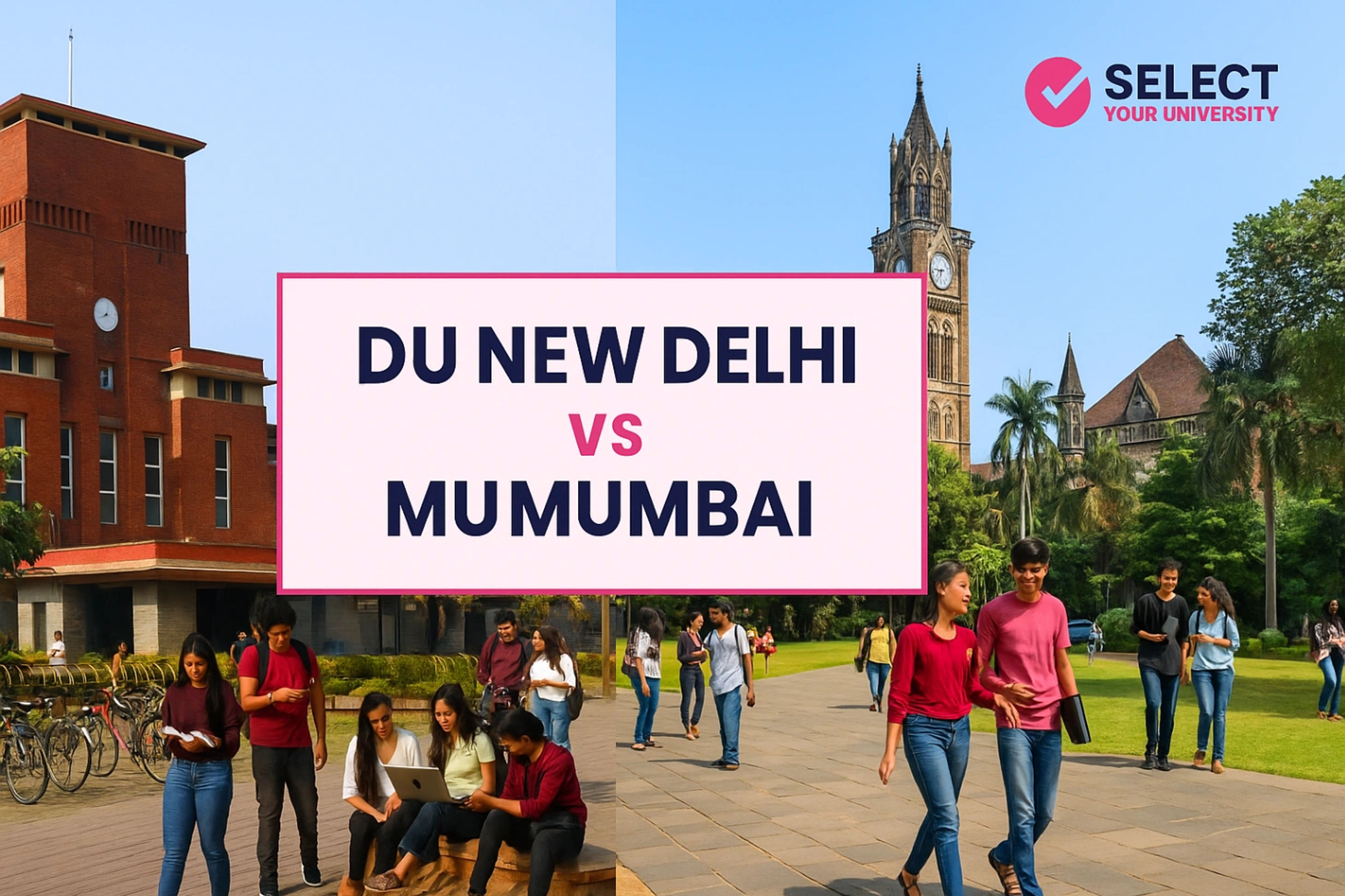 Mumbai University vs Delhi University
 Both Mumbai University and Delhi University are India's leading public universities that offer engineering programs at affiliated colleges. While both follow a similar academic structure for their B.Tech programs, the admissions process, fees, and placement outcomes are different.
For engineering programs, Mumbai University admits students based on the score of the MHT CET examination, while Delhi University's Faculty of Technology students must complete JEE Main and then register for centralized counselling. Furthermore, both programs differ sharply in terms of cutoffs: for example, Mumbai's top colleges like VJTI and SPIT have cutoffs at 95+ percentile in MHT CET exam, Delhi University's B.Tech program requires JEE Main ranks. Whereas for Mumbai University, the colleges for engineering have been around a long time and the fees are incredibly reasonable. Some of the top institutes; VJTI, SPIT charge around ₹1-₹1.5 lakh/year. DU's Faculty of Technology charges ₹2.65 lakh/year, which is much more than Mumbai University.
Mumbai University has the most seats in a lot of colleges and has a greater range of options. The premier colleges here also have good placements, around the average package of ₹6–8 LPA. Delhi University offers fewer seats per branch, and engineering placements are yet to take off, but companies like TCS and Infosys are already hiring participants from campus.
Mumbai University vs Delhi University: Quick Highlights
Below is a table that shows quick comparison highlights of Mumbai University and Delhi University:
Parameter | Mumbai University | Delhi University |
Established | 1857 | 1922 |
Type | Government Public University | Government Central University |
Popular Courses | B.Tech, B.Com (Hons), B.A. (Hons), M.A., MBA | |
Total Seats (Engineering) | Varies by college; top colleges like VJTI offer 60–120 seats per branch | 120 seats per branch in B.Tech (CSE, ECE, EE) |
Fees (Engineering) | ₹1–1.5 Lakhs per year, depending on college | ₹2.65 Lakhs per year |
Average Package (Engineering) | ₹5.3–9.7 LPA depending on college | ₹8.5 LPA (Faculty of Technology) |
Highest Package (Engineering) | ₹9.75 LPA | ₹54 LPA |
Admission Exams | MHT CET, JEE Main (varies by college) | JEE Main |
Accreditation | NAAC A++ Accredited, UGC Recognized | NAAC Accredited, UGC Recognized |
Mumbai University vs Delhi University: Course Details
Below is a table that shows differ in configurations, duration, and formats, medium of instruction, campus facilities, etc. of the flagship courses of Mumbai University and Delhi University.
Particulars | Mumbai University | Delhi University |
Course Type | Undergraduate B.E./B.Tech in Computer Engineering (via affiliated colleges like VJTI, SPIT) | Undergraduate B.Tech in CSE, ECE, EE |
Duration | 4 Years | 4 Years |
Mode | Full-time, residential (varies by college) | Full-time, residential |
Number of Specializations | Varies by college; includes Computer, IT, Electronics, Mechanical, etc. | 3 branches: Computer Science, Electronics & Communication, Electrical Engineering |
Internship | Mandatory industry internship in final year (college-specific) | Mandatory industry internship (usually in 3rd or 4th year) |
Medium of Instruction | English | English |
Campus Facilities | Labs, hostels, libraries, sports grounds (varies by college) | Labs, hostels, library, sports block, temporary campus at Maharishi Kannada Bhavan |
Mumbai University vs Delhi University: B.Tech. Course Fees
Here is a comparison of the B.Tech course fees for Mumbai University and Delhi University in tabular form:
Course | Mumbai University | Delhi University |
B.Tech | ₹1,00,000–₹1,50,000 per year (varies by college, like VJTI, SPIT) | ₹2,65,000 per year (Faculty of Technology) |
Mumbai University vs Delhi University: B.Tech. Admission Process
Both institutes offer the B.Tech program through JEE Main result, and MHT CET result followed by CAP counselling and DU Faculty of Technology counselling. Below is a table that displays the differences between Mumbai University and Delhi University admission processes.
Particulars | Mumbai University B.Tech Admission | Delhi University B.Tech Admission |
Accepted Exams | MHT CET (for Maharashtra colleges like VJTI, SPIT) | JEE Main |
Eligibility | 10+2 with Physics, Chemistry, Mathematics; admission based on MHT CET rank | 10+2 with Physics, Chemistry, Mathematics; admission based on JEE Main CRL rank |
Selection Process | MHT CET rank → CAP Counselling → seat allotment | JEE Main rank → DU Faculty of Technology Counselling → seat allotment |
Mumbai University vs Delhi University: Cutoff
Below are the JEE Main 2025 ranks of Mumbai University cutoff and Delhi University cutoff for comparison.
Category | Mumbai University Cutoff (MHT CET Rank) | Delhi University Cutoff (JEE Main AIR) |
General (UR) | VJTI Mumbai CSE: Closing Rank – approx. 9,500 | DU Faculty of Technology CSE: Expected Closing Rank – approx. 9,000–11,000 |
OBC-NCL | VJTI Mumbai CSE: Expected Rank – approx. 12,000–15,000 | Expected Closing Rank – approx. 4,000–6,000 |
SC | VJTI Mumbai CSE: Expected Rank – approx. 18,000–22,000 | Expected Closing Rank – approx. 2,500–3,500 |
ST | VJTI Mumbai CSE: Expected Rank – approx. 25,000–30,000 | Expected Closing Rank – approx. 1,500–2,500 |
Mumbai University vs Delhi University: Total Seats
Here is a quick overview of the total seats available in some flagship courses at Mumbai University and Delhi University to compare their academic capacity.
Courses | Mumbai University Seats | Delhi University Seats |
B.Tech | VJTI Mumbai: 60–120 seats per branch | 360 seats across CSE, ECE, EE branches |
M.Tech | Varies by specialization; approx. 25–30 seats per branch | Varies by specialization; approx. 25–30 seats per branch |
Ph.D. | Limited seats; varies by research area | Limited seats; varies by department |
Mumbai University vs Delhi University: Placements
Below is a comparison of Placements for Mumbai University and Delhi University in tabular format.
Parameters | Mumbai University | Delhi University |
Median Salary (B.Tech) | ₹5.3–6.5 LPA (varies by college like VJTI, SPIT) | ₹8.5 LPA (Faculty of Technology) |
Highest Salary (B.Tech) | ₹9.75 LPA | ₹54 LPA |
Students Placed (B.Tech) | Most eligible students placed in top colleges like VJTI, SPIT | 100% placement reported for CSE batch |
Mumbai University vs Delhi University: Accreditation & Approval
Below is a table that displays the Accreditation and Approval of Mumbai University vs Delhi University.
Particulars | Mumbai University | Delhi University |
Accreditation | Recognized by UGC; NAAC Accredited with A++ Grade | Recognized by UGC; NAAC Accredited with A+ Grade DU |
Approval | Approved by AICTE and the Government of Maharashtra | Approved by AICTE and the Government of India |
Mumbai University vs Delhi University: Infrastructure & Facilities
Below is a brief overview of Mumbai University and Delhi University infrastructure, and other available facilities in tabular format.
Particulars | Mumbai University | Delhi University |
Infrastructure Details | Multiple campuses and affiliated colleges; includes libraries, labs, auditoriums, and research centers | North and South campuses; includes academic blocks, central library, labs, and innovation centers |
Hostels Available | Yes – Hostels available in select affiliated colleges; availability varies by institution | Yes – Hostels available across North and South campuses for UG and PG students |
Hostel Fees | Varies by college; not centrally published | Approx. ₹2,900–₹3,500/month (excluding mess charges) |
Library Access | Central library and college-specific libraries with digital access | Delhi University Library System with digital resources and study zones |
Campus Facilities | Wi-Fi zones, sports grounds, student clubs, auditoriums, and green spaces (varies by college) | Wi-Fi campus, sports complex, student activity centers, medical facilities, and cultural spaces |
Campus Size | Multiple campuses; Fort and Kalina are major ones | Approx. 69 acres (North Campus), 28 acres (South Campus) |
Conclusion
Both Mumbai University and Delhi University have good engineering programs; however, their admission fees, admission process, seat intake, and placement stats are either better or worse, one another. Mumbai University has a bigger reach and more economical cost through its affiliated colleges when compared to Delhi University's centralized and competitive enrollment. The university that you choose will depend on which entrance exam you have taken, what you can afford, and what type of university atmosphere you want.
Mumbai University vs Delhi University: FAQs
Ques: How does the student life compare at Mumbai and Delhi University?
Ans:
- Mumbai University: There is student life, but it depends on the college, and the central campus culture is limited to urban campuses, which expose students to industries.
- Delhi University: Known for strong student unions, cultural festivals, sports clubs, and strong hostel life on the North and South campuses.
Ques: What are the strengths and weaknesses of Mumbai University?
Ans:
- Strengths: Huge footprint, cheap fees, large numbers of affiliated colleges, and decent placements at top institutes.
- Weaknesses: The infrastructure and academic quality of the colleges that are affiliated vary greatly from one college to the next, and you obviously don't have the same level of centralised reputation as a DU.
Ques: Can we find ranking comparisons between Mumbai and Delhi University for 2024?
Ans: In NIRF 2024, we see Delhi University as higher ranked nationally for central universities. Mumbai University is still highly regarded and respectable, but is lower ranked overall when compared to Delhi University, as a whole alumni base is broader, and obviously, with extensive affiliated colleges, the number of happy students and/or based on lower alumni and international applicant comparabilities.
Ques: How do Mumbai University vs Delhi University campus facilities and infrastructure compare?
Ans:
Mumbai University has multiple campuses (Fort and Kalina), while affiliated colleges have libraries, labs, auditoria, and sports grounds etc. The facilities of colleges vary.
Delhi University has centralized North & South campuses with modern libraries, wifi, hostel facilities, student activity centers, and research facilities.
Ques: For a student interested in economics, which university is better: Mumbai or Delhi?
Ans: Delhi University has an elite Economics department, with high placement and quality faculty. Mumbai University is still a reasonable place for economics study, but Delhi has prestige and is known as a better university for economics and not as good.