




KCET Eligibility Criteria 2026: Age Limit, Domicile, Reservation & Required Documents
Karnataka Common Entrance Test
KCET Eligibility Criteria 2026 Overview
Students are required to fulfil the KCET 2026 eligibility criteria to participate in the exam. To be eligible for the exam, students must have passed 10+2 in any stream from a recognised board.
Applicants are supposed to meet the nationality and domicile regulations that have been established by the Karnataka Examinations Authority. The eligibility depends on the course, and subject combinations are essential in the engineering programs, pharmacy, nursing, and agriculture programs, 10 + 2. There are age qualifications based on the stream, with the relaxed categories being provided based on the government norms. To participate in counselling and seat allotment, it is a requirement to have a minimum academic qualification. Before applying to KCET 2026, the official guidelines must be checked thoroughly, and the candidate must justify the application of all the eligibility criteria.
KCET 2026 Eligibility Criteria 2026: Quick Highlights
Mentioned below Karnataka B.Sc. Nursing Entrance Exam Eligibility criteria, which is conducted by KEA.
Eligibility Criteria | Details |
Nationality | Candidate must be an Indian National or a Person of Indian Origin (PIO) / Overseas Citizen of India (OCI) cardholder. |
Domicile | Candidate must belong to Telangana or Andhra Pradesh and satisfy local/non-local status requirements as per state government rules. |
Age Limit (Engineering & Pharmacy) | Minimum 16 years of age as of 31 December of the admission year. No upper age limit. |
Age Limit (Agriculture, Dairy, etc.) | Minimum 17 years and maximum 22 years as of 31 December (25 years for SC/ST candidates). |
Educational Qualification – Engineering Stream | Must have passed or appeared in 10+2 with Mathematics, Physics, and Chemistry or equivalent vocational courses. |
Educational Qualification – Agriculture Stream | Must have passed or appeared in 10+2 with Physical Sciences and Biological Sciences or Agriculture subjects. |
Minimum Marks in Qualifying Exam | At least 45% marks (40% for reserved categories) in group subjects in 10+2 or equivalent. |
TS EAMCET Qualifying Marks | Minimum 25% marks required to qualify. No minimum qualifying marks for SC/ST candidates, but ranking depends on performance. |
Eligibility for Pharm D Course | Must have passed 10+2 with Physics, Chemistry, and Mathematics or Biology. Minimum age: 17 years by year-end of admission. |
Appearing Candidates | Students appearing for their final 10+2 exams are eligible to apply, provided they meet eligibility at the time of admission. |
KCET 2026: Documents Required
Candidates should carefully verify the following details printed on the admit card:
- Candidate’s name
- KCET application number
- Roll number
- Photograph and signature
- Exam date and time
- Exam center name and address
- Course/subject details
- Reporting time
- Exam day instructions
- Authority signature/seal
Karnataka Common Entrance Test
KCET Eligibility Criteria 2026
Refer to the table below to check the eligibility criteria for the KCET exam:
Course | Eligibility |
B.Tech Course |
|
B.Arch Course |
|
B.Pharm Course |
|
KCET 2026 Eligibility Criteria: Nationality
KCET Nationality Eligibility Criteria includes candidates of Indian nationals, Persons of Indian Origin (PIO), or Overseas Citizen of India (OCI) cardholders.
Particulars | Details |
Citizenship | Candidate must be an Indian citizen |
PIO / OCI Eligibility | PIO and OCI cardholders are eligible as per Karnataka rules |
Domicile Requirement | Must satisfy Karnataka local eligibility/domicile norms defined by KEA |
Regional Eligibility | Hyderabad-Karnataka / Kalyana Karnataka reservation applicable as per government rules |
KCET 2026 Eligibility Criteria: Age Limit
The KCET 2026 age criteria for medical is 17 years, and there is no upper age limit. Check the table for other course type age limit criteria.
Course Category | Age Requirement |
Engineering / Pharmacy / General courses | No fixed upper age limit (minimum age as per course norms) |
Medical / Allied courses | Minimum 17 years by 31 December of the admission year |
Reserved Categories | Age relaxation applicable as per government norms |
KCET 2026 Eligibility Criteria: Courses
KCET 2026 is conducted for admission into different streams like Engineering (E), Agriculture & Medical (AM), and Pharmacy. Check the eligible courses mentioned below.
Course | Required Subjects in 10+2 |
B.E / B.Tech | Physics, Mathematics, Chemistry |
B.Pharm | Physics, Chemistry + Biology/Mathematics |
Pharm D | Physics, Chemistry + Biology/Mathematics |
BSc Nursing | Physics, Chemistry, Biology |
Veterinary Sciences | PCB (Physics, Chemistry, Biology) |
Agriculture Courses | PCB / Agriculture subjects |
Dairy / Food / Agricultural Engineering | PCM (Physics, Chemistry, Mathematics) |
Karnataka Common Entrance Test
KCET 2026 Syllabus: Subject-wise Topics for Physics, Chemistry, Maths & Biology
The KCET 2026 syllabus is the first step toward preparation. The KCET syllabus is divided into four subjects: Mathematics/Biology, Physics, and Chemistry. It does not have a fixed syllabus, but based on previous years, the major questions are mostly from these areas. Refer to the table below for all the details of the KCET syllabus:
Subjects | Important topics |
Physics | Mechanics (Work, Energy, Power, Laws of Motion), Thermodynamics (Laws of Thermodynamics, Heat), Optics (Refraction, Lenses, Reflection), Gravitation (Satellites, Universal Law of Gravitation), Electrostatics (Electric field, Electric chnarges, Coulumb’s law), Mechanical properties of solid, Kinetic energy, Oscillation, Waves. |
Mathematics | Calculus (Continuity, Differentiation, Integration), Algebra (Progressions, Polynomials, Quadratic equations), Trigonometry (Heights & Distance, Trig Ratios), Linear inequalities, Statistics, Probability. |
Chemistry | Organic chemistry (Phenols, Ethers, Hydrocarbons, Alcohols), Physical chemistry (Chemical bonding, Atomic structure, Mole concept), Chemical kinetics (Arrhenius equation, Rate of reaction), Inorganic chemistry (d-block elements, p-block elements), Equilibrium, Hydrocarbons, Environmental chemistry, Hydrogen. |
Biology | Human Physiology (Excretory system, Circulatory system), Cell Biology (Enzymes, Cell structure, Metabolism), Plant and Animal Physiology (Respiration, Photosynthesis), Genetics and Evolution (Darwin’s theory of evolution, Heredity), Locomotion and movement, Chemical coordination and integration. |
Karnataka Common Entrance Test
KCET Preparation Tips 2026
KCET scores are considered for admission to various programs in colleges in Karnataka. However, with the right preparation and strategies, candidates can get a good score and rank in the KCET exam. Here are some KCET 2026 preparation tips that need to be followed:
- The candidate must understand the exam pattern and syllabus and be familiar with the KCET exam pattern.
- The candidate must make a practical study schedule and divide time subject-wise, and include weekly mock test sessions.
- The candidate must stick to the NCERT books and practice the question banks and previous year question papers.
- The candidate must practice mock tests regularly and review their mistake to improve recovery.
- The candidate must keep short notes for quick revisions and revise important formulas and concepts weekly.
Karnataka Common Entrance Test
Latest News
KCET 2026 Final Seat Allotment Result (Out): Check College Allotment, Download Allotment Order
Shreyosee • 1 Mins read • 14 Jul 26

KCET 2026 Round 1 Provisional Seat Allotment Result (Out): Check Allotment Status & Cut-Off
Shreyosee • 1 Mins read • 14 Jul 26
KCET 2026 Round 1 Mock Seat Allotment Result Released: Check Allotment, Option Entry & Final Schedule
Shreyosee Chakraborty • 1 Mins read • 5 Jul 26

KCET Counselling 2026 Begins: KEA Opens Choice Filling, Verification Slip Download & Seat Allotment Details
Shreyosee Chakraborty • 1 Mins read • 21 Jun 26

KCET Result 2026 Declared: Check UGCET Scorecard, Toppers List, Rank Card & Download Process
Shreyosee Chakraborty • 1 Mins read • 5 Jun 26
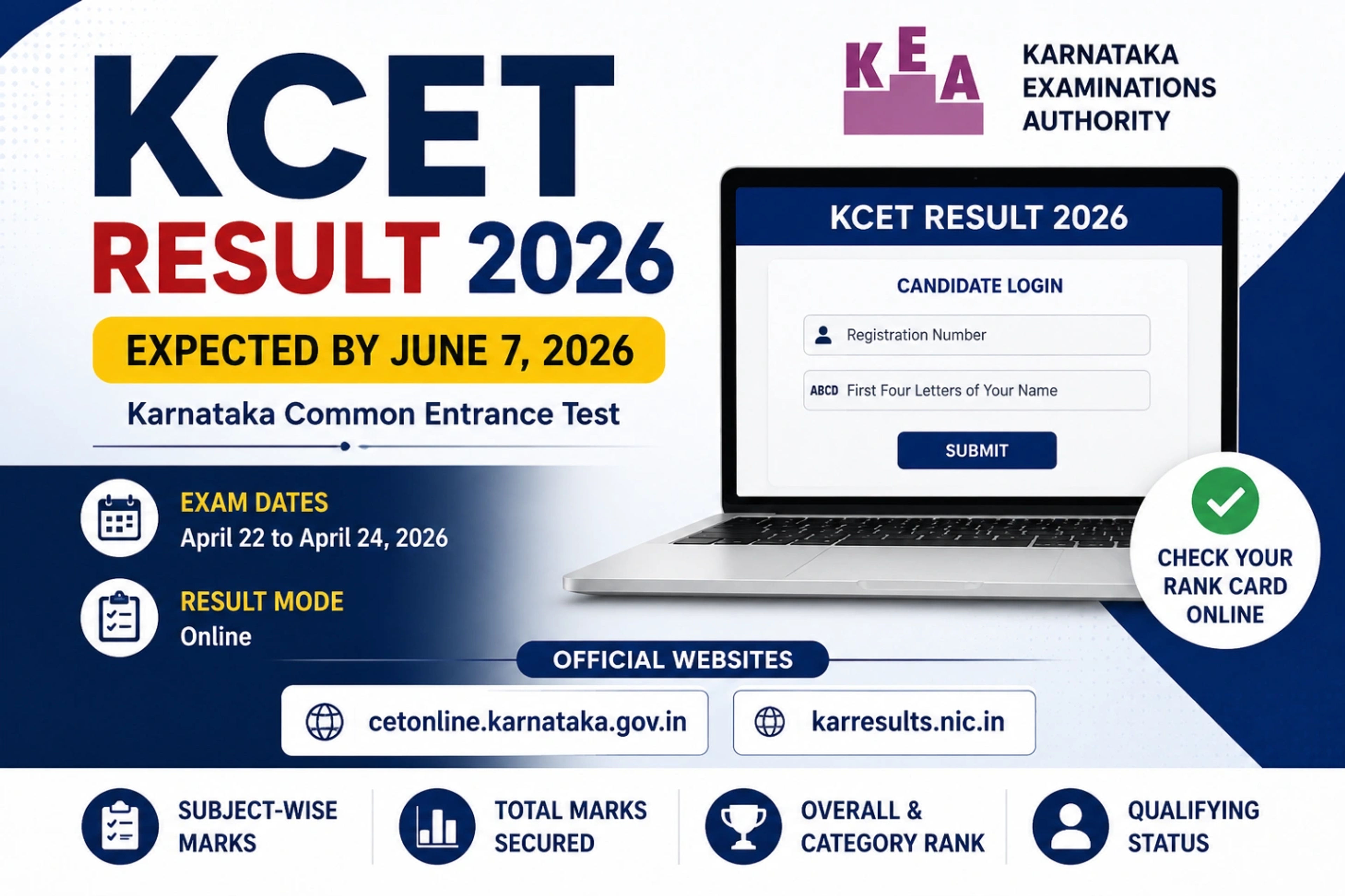
KCET Result 2026: Expected Release Date, Rank Card Download Link & Counselling Details
Jyoti • 1 Mins read • 26 May 26

KCET 2026 Counselling: Dates, Process, Eligibility, KEA Admission Schedule & Latest Update
Pragati Srivastava • 1 Mins read • 21 May 26
KCET 2026 Notification Out:Application Form, Dates, Eligibility & Major Changes
Lakshmi Singh • 1 Mins read • 18 Jan 26

KCET 2026 Fee Payment Deadline Extended to 7 March; Revised Schedule
Lakshmi Singh • 1 Mins read • 5 Mar 26
Karnataka Common Entrance Test

Not sure what you are looking for? Connect with our counsellors.
Login helps you find curated results for your requirement.