

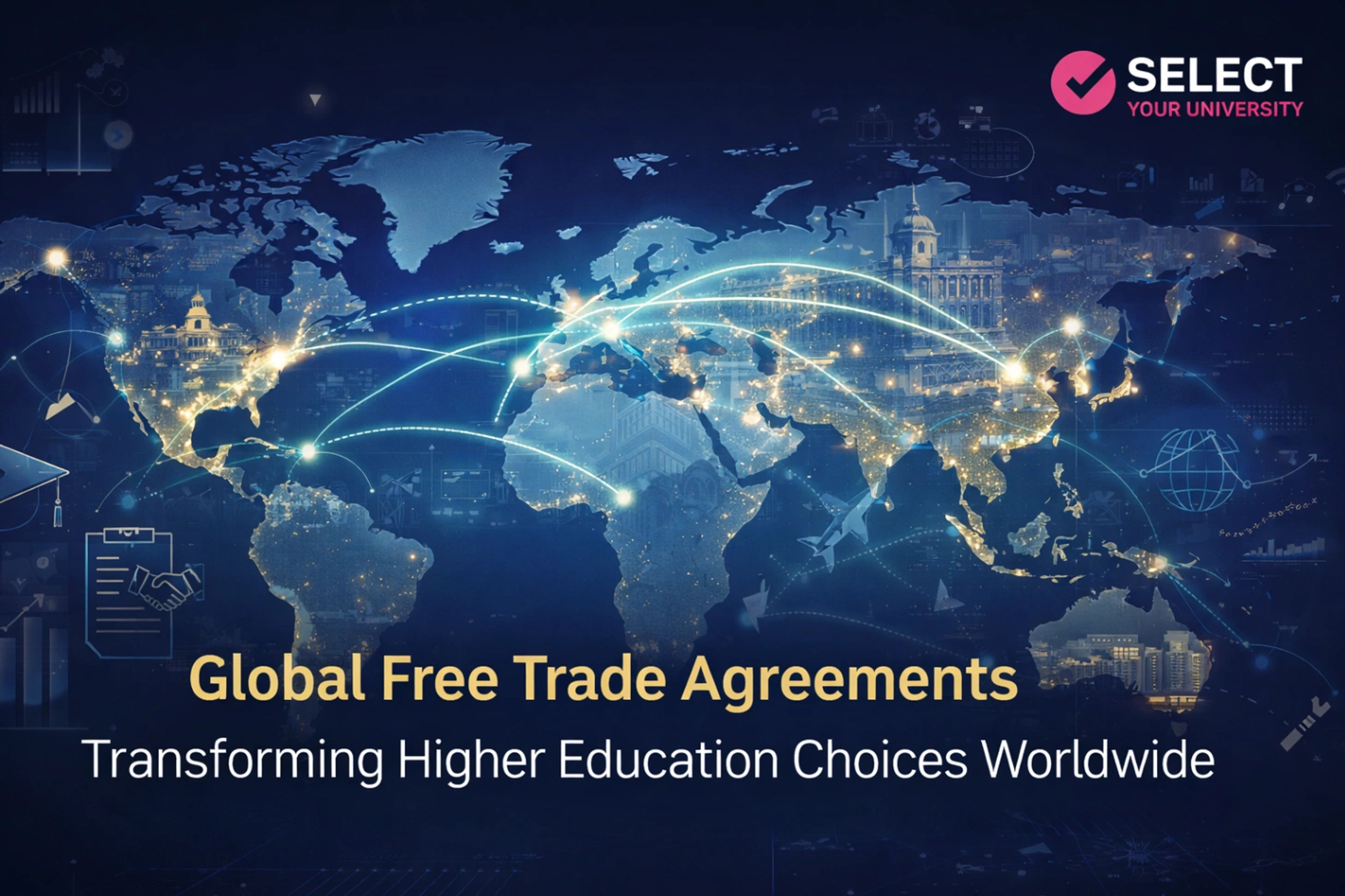
Trade Agreements Reshaping Study Abroad for Indian Students 2026
 India Overtakes China as Leading Source of International Students
Did you know that India has surpassed China in terms of the largest international student source.
ET ED Insight, in its report, writes that the authority of international higher education has shifted. The market is not shaped by education giants but by the students. Indian students, if we are to say precisely. Indian students now make up one of the largest pools of international students, thus shaping the market. The trend echoes when Record overseas student spend of ₹6.3 trn sharpens focus on developing global opportunities within India.
Study abroad in 2026 is set to see major shifts. In the past 20 years, policymakers, negotiators, and diplomats were stuck with boardrooms to policy drafts. Many of these partnerships will not become visible when implementation takes place. But on 20 February 2026, European Commission President Ursula von der Leyen, European Council President Antonio Costa, and Indian Prime Minister Narendra Modi stood at the Hyderabad House.
☎️ Talk to an Expert Counsellor — FREE Call ☎️ |
|---|
What came from this trio?
The EU-India Free Trade Agreement. Now, study in UK will become more feasible.
Yes…once a highly unlikely thought deal was sealed. The historic EU-India Free Trade Agreement was signed with the gaze of the global media.
India reciprocates through: Reduced the Tax Collection at Source (TCS) to 2% on education-related remittances under the LRS.
But do you think it is a one-day deal? No.
It demonstrates a bigger and quieter shift. It has more than applause and headlines. The agreement is not only about trade and tariffs. It also signals:
- New economic corridors
- New talent pathways
- New global possibilities
India and Gulf Cooperation Council (GCC) partnership also shows a greater transformation.
Today, students are watching closely. Now, global rankings or campus prestige do not solely attract the intake. It is becoming a strategic choice. Now, study abroad for Indian students' futures emerges from trade routes, labour mobility agreements, and international employment ecosystems. Academic choice now walks hand in hand with geopolitics. And it becomes worth noting when Four Leading Countries are Toughening Visa Policies and Costs 2026.
In a world shaped by trade agreements, the smartest classroom choice is the most strategic career move.
Trade Volumes Are Reshaping Student Mobility Patterns
Let’s be empirical and see what the data shows.
Trade Corridor | Trade Volume (2018-2023) | Impact on Education |
India–EU | USD 180+ billion annually | Growth in Indian enrollments in EU |
India–GCC | USD 240+ billion annually | Rising demand for applied programs |
Study in UK Aspirants’ Guide:
☎️ Talk to an Expert Counsellor — FREE Call ☎️ |
|---|
A large share of professional services:
- Engineering
- Healthcare
- Finance
- Logistics
- Digital services
Take these corridors.
Trade and education go side by side. As the trade intensifies, enrollments also rise. EU and GCC countries see faster rates than traditional study abroad destinations.
Mutual Recognition of Qualifications Reducing Credential Risk
India-EU FTA negotiations focus on:
- Professional mobility
- Regulatory cooperation
- Qualification recognition
The outcomes can be seen due to EU’s standardized system:
- EU cross-border tertiary enrollment increased: 30%
What this means for students:
- Degree devaluation faces less risk
- Easier post-study work
- Greater international credential portability
The trend is that credential portability attracts students more than institutional ranking. And we do not say this as a study abroad enthusiast. The workforce mobility datasets solidify this claim.
India’s Global Education and Trade Collaborations: Developments
As global education navigators, we know how hectic it is to track each and every education-related info. So here we present a comprehensive guide:
Category | Updates |
Trade Agreements | |
India and Germany Set New Plan for Higher Education Cooperation | |
MoUs and Institutional Collaborations | India Invites Canadian Universities to Open Campuses in India |
Profi University Signs MoU with Pravara Hospital for Global Academic | |
Visa Mobility Policies | |
Medical Education & Healthcare Collaborations | |
Profi University Signs MoU with Ruby Hall Clinic for Internship Opportunities |
GCC Education Investments Fueling Study Abroad Demand
The Gulf Cooperation Council (GCC) shows the same insight.
GCC governments have invested:
- Over $100 billion in higher education
- Universities and applied research centers
- Economic diversification institutes
Do you know?
- GCC institutions' enrollment of Indian students: 12-15% increase per year.
- It is higher than the global outbound growth rate of under 7%.
Fast-Growing Academic Programs in Trade-Linked Regions
- Data Analytics
- Supply Chain Management
- Sustainability Engineering
- Health Administration
- Fintech
Some Favourable Developments for India:
- India Invites Canadian Universities to Open Campuses Locally
- Education Gets a Bigger Slice in Union Budget 2026: Funding Up 8.2%
Labour Market Stability Driving Long-Term Education Planning
38% of India’s skilled migration flows are accounted for by the EU and GCC economies.
This stability matters, especially when it's structured.
Students today want:
- Predictable immigration policies
- Post-study work alignment
- Long-term employment
And how do these trade-integrated regions help?
They provide more stable regulatory frameworks. This stability makes the transition easier for students.
Cost and Risk Optimization Influencing Destination Choice
Let’s talk numbers.
If you compare master’s programs in Europe from North America, the former is 30-45% cheaper.
Now watch this percentage with a perspective:
- Post-study work rights
- Wage convergence in professions
- Absorption of the strong industry
You will have an easy prediction of the total return on education.
In GCC countries:
- Shorter program durations
- Strong job absorption in infrastructure and services
- Lower overall cost-risk ratio
Students get that predictability here. It secures them from uncertain upheavals.
Universities Responding to Trade-Driven Education Shifts
Universities of trade-integrated regions adapt to the shift. They:
- Align curriculum with cross-border employability
- Co-design industry programs
- Integrate work with learning
- Sustain research collaboration with digital transformation
Modern trade agreements look at:
- Digital infrastructure
- Sustainability standards
- Professional mobility
- Research collaboration
Employers now value these:
- Regulatory awareness
- Cross-border compliance knowledge
- Interdisciplinary adaptability
And when higher education institutions fail to align, it becomes outdated.
Europe, India and Changing Mobility Trends
Why study in Europe for Indian students is in demand:
- Sustainability
- Finance
- Data Analytics
- Public Policy
- Applied Research
The EU-India FTA will provide a base for collaboration and mobility of skill.
OECD data also shows:
- Growth in short-term, skill-based exchange courses
- Joint certifications
- Industry internships
- Collaborative doctoral supervision
Education Choices Are Shifting from Prestige to Trade-Aligned Careers
The result of trade agreements is not temporary. They indicate a structuralimpact:
Higher Education Shift
Earlier | Now |
Prestige signaling | Trade-aligned career signaling |
Choosing based on rankings | Choosing based on career opportunities |
Focus on university brand | Focus on global job markets |
Status-driven decisions | Strategy-driven decisions |
What Study Abroad Students Are Evaluating Today
Factor | Why It Matters |
Labour mobility | Can I work there after graduation? |
Regulatory convergence | Will my degree be recognised? |
Employment ecosystems | Are there strong industries and job networks? |
Economic bloc stability | Is the region economically stable long term? |
What we learn: Global economic partnerships are shaping career pathways (quietly). If you also plan to go abroad for your studies and think factoring in trade agreements is not a smart decision, think again.
Explore Study Abroad Destinations by Country
Top Countries to Study Abroad in 2026 | |
☎️ Talk to an Expert Counsellor — FREE Call ☎️ |
|---|
The Bigger Picture for Students Planning to Study Abroad
Therefore, we can safely draw these insights from the present negotiations among world leaders who see education as an indispensable instrument in diplomacy.
- Trade corridors are influencing job markets.
- Qualification recognition reduces your risk in study abroad.
- Your employability benefits from regulatory alignment.
- Long-term stability rests on the foundation of economic integration.
Study abroad for Indian students now choose those partnerships that translate into internships. Now you do not choose a university but an economic ecosystem. And yes, the boardroom has indeed formed a connection with the classroom…a stronger one on that. And the smartest students are paying attention.