


NEET UG 2026 State Quota Eligibility: State-Wise Domicile Rules, Cutoffs & Counselling Guide
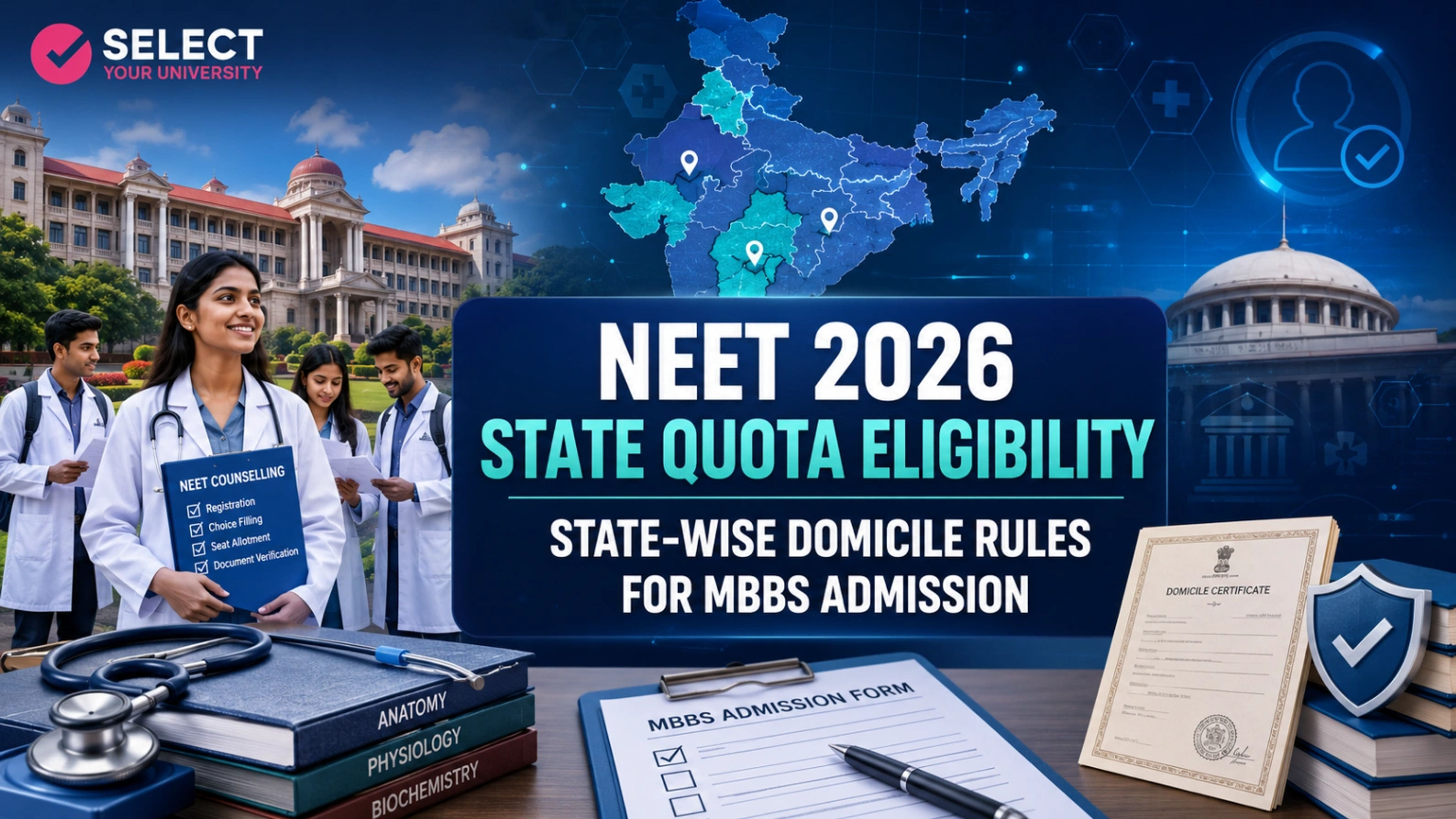 NEET UG 2026 State Quota Eligibility State-Wise Domicile Rules
Latest Updates
- NEET UG 2026 Result and cut-offs have been released by the NTA.
- Candidates can now prepare their documents for the counselling process.
- MCC will announce the NEET UG 2026 Counselling schedule on its official website. Candidates should check the released schedule before relying on tentative dates.
- State counselling authorities will separately announce registration dates for 85% State Quota seats.
- Candidates should check their domicile, schooling and residence eligibility before registering for state counselling.
If you are preparing for NEET UG 2026, it is as crucial to know your expected cutoff as it is to know your state quota eligibility. Every year thousands of candidates miss the opportunity to get an MBBS seat simply because they are unaware of their state domicile rules. All India Quota (AIQ) fills 15% of the seats in government MBBS colleges, and the remaining 85% State Quota seats are filled under the eligibility rules laid down by the respective states. These rules differ a lot from state to state.
This guide explains the NEET 2026 State Quota Eligibility, state-wise domicile criteria, required documents, and important exceptions to help you participate in the correct counselling process.
☎️ Speak to a NEET Admission Expert — FREE Call ☎️ |
|---|
NEET 2026 Institutional Quota Eligibility
Some medical institutions follow their own institutional quota rules. These seats may depend on the candidate’s place of schooling or association with the institution. Institutional quota rules differ from the standard state domicile criteria. Candidates should check both conditions before selecting colleges during counselling. Refer to the table below for details on NEET 2026 institutional quota eligibility.
Institution | NEET 2026 Institutional Quota Eligibility |
|---|---|
Delhi University | In Lady Hardinge Medical College, University College of Medical Sciences, and Maulana Azad Medical College, 85% of seats are reserved for candidates who completed Class 12 from a recognised school in Delhi. The remaining 15% are filled through the All India Quota. |
Aligarh Muslim University | AMU reserves 50% of its seats for candidates who studied in recognised AMU schools during the previous three years. The remaining 50% are filled through All India counselling. |
Banaras Hindu University | BHU does not have a state domicile quota for these seats. Eligible candidates from across India can participate through All India counselling. |
Faculty of Dentistry, Jamia Millia Islamia | The institution offers 47 seats to All India candidates. Three seats fall under the internal quota for candidates who passed Class 12 from Jamia schools. |
GGSIPU Institutions | In VMMC and Safdarjung Hospital, 85% of seats are reserved for candidates who completed Class 12 from Delhi. The remaining 15% are filled through the All India Quota. |
What is the NEET State Quota?
Under NEET counselling, government medical college seats are divided into two categories:
Quota | Seats | Counselling Authority | Eligibility |
All India Quota (AIQ) | 15% | MCC | Available to candidates from all the states |
State Quota | 85% | Respective State Counselling Authorities | State specific Domicile or eligibility requirements |
Every state conducts its own counselling for 85% of government MBBS and BDS seats and follows separate domicile or residency requirements.

What is a Domicile Certificate?
A domicile certificate is a certificate issued by the state government to prove that a candidate is a permanent resident of that state. It is one of the key documents required for claiming admission under 85% State Quota.
Depending on the state, eligibility may also be based on:
- Permanent residence
- Number of years of schooling
- Parents' domicile
- Employment of parents in the state
- Special categories such as defence personnel or government employees
A domicile certificate is not the only method used to determine State Quota eligibility. Some states consider the candidate’s schooling, years of residence, nativity or the employment status of the parents. A candidate may therefore qualify under one condition even when a separate domicile certificate is not required. The exact requirement must be checked in the state’s NEET UG 2026 counselling information bulletin. This clarification is important because states such as Delhi primarily use schooling criteria, while others use residence, parental domicile or government-service conditions.
☎️ Speak to a NEET Admission Expert — FREE Call ☎️ |
|---|
NEET State Quota Eligibility 2026: State-Wise Domicile Rules
Refer the table below to know the eligibility criteria for state wise domicile admission for MBBS/BDS:
State/UT | NEET 2026 State Quota Eligibility |
Andhra Pradesh |
|
Arunachal Pradesh |
|
Assam | Candidates must have studied from Class 7 to Class 12 in Assam. The candidate or either parent should also have been a permanent resident of Assam for at least 20 years. Candidates must fulfil the prescribed medical fitness requirements. |
Bihar |
|
Chandigarh |
|
Chhattisgarh |
|
Dadra & Nagar Haveli & Daman & Diu |
|
Delhi | Candidates must have passed Classes 11 and 12 from a recognised school located within the National Capital Territory of Delhi. The qualifying education may be completed through CBSE, CISCE, Jamia Millia Islamia or another recognised equivalent board. |
Goa | Candidates must have passed Class 12 from a recognised school or college in Goa. They should ordinarily have resided continuously in Goa for ten years before applying. |
Gujarat |
|
Haryana | Haryana domicile is mandatory for admission under the 85% State Quota in government medical colleges. |
Himachal Pradesh |
|
Jammu & Kashmir |
|
Jharkhand | The candidate must be an Indian citizen and a permanent local resident of Jharkhand. The applicable local residence certificate must be produced during counselling. |
Karnataka | Karnataka domicile candidates may apply for government quota seats. KEA also recognises several eligibility clauses based on schooling, residence and parental employment. |
Kerala |
|
Madhya Pradesh | MP domicile is required for admission under the State Quota in government medical colleges. |
Maharashtra | Candidates should hold Maharashtra domicile or should have resided in Maharashtra for at least ten years. They must also satisfy the educational and document requirements prescribed by the Maharashtra State CET Cell. |
Odisha | Government quota seats are primarily reserved for candidates who satisfy the Union Territory residence requirements. Separate eligibility provisions may apply to:
|
Punjab |
|
Puducherry |
|
Rajasthan |
|
Sikkim | Only candidates holding Sikkim domicile are eligible for the State Quota. |
Tamil Nadu |
|
Telangana | Candidates should have studied in Telangana for four consecutive academic years ending with the year of the qualifying examination. Alternatively, they should have resided in Telangana for four years immediately before the qualifying examination. |
Tripura | Candidates should be Indian citizens and permanent residents of Tripura for at least ten years before applying. They should not hold domicile in another state. The following candidates may also qualify under prescribed conditions:
|
Uttar Pradesh |
|
Uttarakhand |
|
West Bengal |
|
Important Note: State Quota rules may include additional conditions related to schooling, parental service, reservation, nativity and document formats. Candidates should verify their eligibility through the official NEET UG 2026 counselling notification issued by the respective state authority. Meeting the NEET qualifying cutoff alone does not guarantee eligibility for every state’s 85% quota. Separate eligibility details for states and Union Territories such as Manipur, Meghalaya, Mizoram, Nagaland, Ladakh, Andaman and Nicobar Islands and Lakshadweep are not included in the table above.
Dont Miss:Total MBBS Seats in India 2026: State-Wise Seat Matrix, Government & Private Colleges
☎️ Speak to a NEET Admission Expert — FREE Call ☎️ |
|---|
States Where Non-Domicile Candidates Can Apply
The 85% government State Quota is generally limited to candidates who satisfy the concerned state’s domicile, residence or educational requirements. However, non-domicile candidates may apply for certain private, management or open-category seats in some states. Eligibility, fees and reservation benefits differ across states and colleges. Candidates should not assume that permission to register makes them eligible for government State Quota seats.
Examples may include:
- Karnataka private and open seats.
- Uttar Pradesh private medical colleges.
- Management quota seats in Haryana.
- Certain private institutions in Rajasthan.
- Management quota seats in Tamil Nadu.
- Management and minority seats in Puducherry.
Documents Required for State Quota Counselling
Candidates may need the following documents during online registration, verification or college reporting:
- NEET UG 2026 scorecard.
- NEET UG 2026 admit card.
- Class 10 marksheet and passing certificate.
- Class 12 marksheet and passing certificate.
- Domicile, nativity or permanent residence certificate.
- Schooling or study certificate, where required.
- Transfer Certificate.
- Migration Certificate, where required.
- Character Certificate.
- Category Certificate for SC, ST, OBC or EWS candidates.
- Non-Creamy Layer Certificate, where applicable.
- PwD Certificate issued by an authorised centre.
- Government-issued identity proof.
- Passport-size photographs.
- Parent’s domicile or residence proof, where applicable.
- Parent’s service certificate for government, defence or PSU categories.
- Local Status Certificate, where applicable.
- Minority, NRI, defence or ex-servicemen certificate, where applicable.
- Counselling registration and payment receipt.
- Provisional allotment letter after seat allotment.
Note: The exact document list differs by state and candidate category. Candidates should use the checklist issued by their respective counselling authority.
Also Read:
Explore Top Government Medical Colleges in India 2026 After Checking State Quota Eligibility
Understanding State Quota eligibility helps candidates identify the states where they can participate in MBBS counselling. The next step is to compare government medical colleges based on the previous counselling cutoffs, seat availability, category and quota. Candidates with moderate NEET UG ranks can explore our detailed guide on Top Government Medical Colleges in India 2026. The guide covers colleges that may have relatively accessible closing ranks compared with highly competitive institutions.
Candidates should compare cutoffs carefully because admission ranks differ across:
- All India Quota and State Quota seats
- General and reserved categories
- Counselling rounds
- States and medical colleges
Check the complete list of government medical colleges with lower NEET cutoffs before preparing your counselling preference order.
Government MBBS College | Expected NEET UG 2026 General Cutoff Rank (AIR) | NEET Marks Range (Approx) |
21,000–21,200 | 540–550 | |
20,800–21,000 | 542–550 | |
20,700–20,950 | 543–550 | |
Tinsukia Medical College & Hospital, Assam | 20,500–20,750 | 545–552 |
Kokrajhar Medical College & Hospital, Assam | 20,400–20,700 | 546–553 |
Nagaon Medical College, Assam | 20,100–20,500 | 549–556 |
20,000–20,450 | 550–557 | |
19,900–20,400 | 551–558 | |
19,600–20,250 | 554–561 | |
19,500–20,200 | 555–562 | |
19,400–20,100 | 556–563 | |
19,300–20,050 | 557–564 |
MBBS Abroad Options After NEET 2026 Include Top Medical Colleges in the World 2026
Candidates who do not secure a suitable seat through AIQ, State Quota or private medical counselling may also research MBBS abroad. Admission rules, course duration, tuition fees and licensing requirements differ across countries. efore choosing an international medical university, candidates should check:
- NEET qualification requirements
- NMC eligibility rules
- Course duration and internship structure
- Teaching language
- Total tuition and living costs
- Clinical exposure
- Licensing requirements after graduation
Candidates can compare recognised options through our guide to the Top Medical Colleges in the World 2026-27. Those considering specific destinations can also explore detailed university list given below.
Top Medical Colleges in the World 2026-27 | |
NEET 2026 State Quota Eligibility: Frequently Asked Questions (FAQs)
Ques. What is the 85% State Quota in NEET 2026?
Ans: The 85% State Quota comprises the government MBBS and BDS seats which are filled by the respective state counselling authorities. Candidates are required to satisfy the State Domicile / Eligibility criteria to participate in the State Quota counselling.
Ques. Is a domicile certificate mandatory for NEET State Quota admission?
Ans: In most of the states, you have to produce a domicile certificate to get admission under 85% State quota. However, some states also include schooling, parents’ residence or government service as part of the eligibility criteria.
Ques. Can I apply for MBBS admission in another state's counselling?
Ans: Yes, you can apply for the 15% All India Quota (AIQ) regardless of your domicile. For the 85% State Quota, you must satisfy the eligibility rules prescribed by the respective state.
Ques. Can non-domicile candidates get admission to private medical colleges?
Ans: Yes. Some states such as Karnataka, Uttar Pradesh and Tamil Nadu allow non-domicile students to apply for seats in management or private medical colleges as per the counselling rules of that state.
Ques. What documents are required for NEET 2026 State Quota counselling?
Ans: Candidates generally need:
- The NEET 2026 scorecard
- Admit card
- Class 10 and 12 mark sheets
- Domicile or residence certificate
- Valid ID proof
- Category certificate (if applicable)
- Passport-size photographs
- Other documents specified by the respective state counselling authority.